
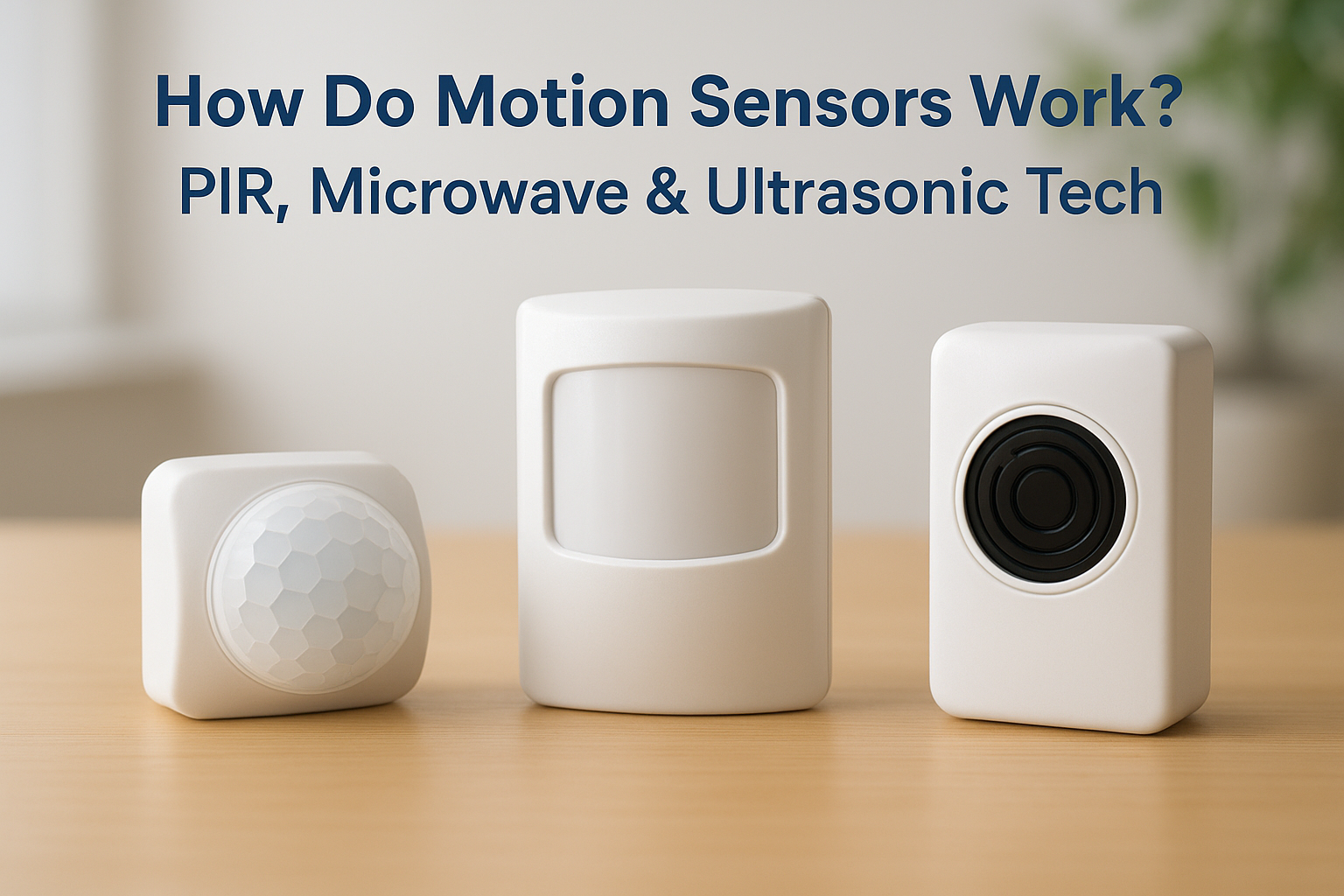
Motion sensors are one of the most practical tools in a paranormal investigator’s kit. They alert you to movement in rooms you’re not watching, flag activity in supposedly empty hallways, and give you a timestamp to cross-reference with audio or video evidence. But if you don’t understand how do motion sensors work at a technical level, you’re stuck guessing whether a trigger was caused by something worth investigating, or just a draft from an old window.
At Haunt Gears, we test and review detection equipment for ghost hunters at every experience level. That hands-on work has taught us that knowing what a sensor detects matters just as much as owning one. A PIR sensor and a microwave sensor can both flag “movement,” but they do it in completely different ways, and each has blind spots that can make or break an investigation in low-activity environments.
This article breaks down the three main motion sensor technologies, passive infrared (PIR), microwave, and ultrasonic, covering how each one detects movement, where it performs best, and which type fits specific investigation scenarios. By the end, you’ll have a clear understanding of the tech inside these devices so you can deploy them with confidence on your next case.
What a motion sensor detects and what it can’t
Understanding how do motion sensors work starts with knowing what they’re actually measuring. No motion sensor directly detects movement the way a camera does. Instead, each type measures a specific physical property of the environment, such as infrared radiation, sound waves, or microwave signals, and flags a reading when that property changes. The sensor doesn’t “see” a person walk by; it registers a disruption in its baseline measurement and interprets that disruption as motion.
What motion sensors actually detect
Every motion sensor operates by establishing a baseline reading of its environment and then watching for deviations from that baseline. A PIR sensor tracks the infrared heat signatures present in a room when nothing is moving. A microwave sensor emits radio waves and monitors how those waves return. An ultrasonic sensor sends out sound pulses and times their echo. In all three cases, the detection trigger is a change, not the presence of a body itself. This distinction matters for investigators because it means environmental variables like heat vents, reflective surfaces, and even insects can produce false positives that look exactly like genuine detections.
Motion sensors detect changes in a physical signal, not movement itself, so anything that alters that signal can trigger an alert.
Here’s what each sensor type actually responds to:
- PIR sensors: Changes in infrared heat across the sensor’s field of view
- Microwave sensors: Doppler shifts in reflected radio waves caused by any movement
- Ultrasonic sensors: Changes in the time it takes for a sound pulse to return to the sensor
Where motion sensors fall short
Knowing the limits of a sensor is just as important as knowing its strengths. PIR sensors are blind to slow-moving objects because the infrared change happens too gradually to cross the detection threshold. A person moving very slowly through a PIR’s field of view may not trigger it at all. Similarly, glass and solid walls block PIR sensors entirely because infrared radiation does not pass through those materials.
Microwave sensors penetrate walls and can detect movement in adjacent rooms, which sounds like an advantage until you realize it’s also a major source of false triggers. Pets, insects, and vibrations from nearby traffic can all register as a detection event. Ultrasonic sensors are highly sensitive to air turbulence, so anything that disturbs airflow in the room, like a heating system cycling on, can produce a false alarm with no physical cause worth documenting.
For paranormal investigations specifically, these blind spots carry real consequences. Your review of footage may expect a correlation between a sensor trigger and something visual, only to reveal the alert came from a nearby HVAC vent or a moth crossing the detection zone. Understanding the sensor’s physical limitations lets you rule out mundane explanations before drawing any conclusions from your data. Placing sensors away from heat sources, air vents, and reflective surfaces dramatically reduces noise in your detection log and gives you cleaner, more credible evidence to analyze after the investigation wraps up.
Why motion sensors matter in homes and investigations
Motion sensors show up in two very different contexts: everyday home security systems and specialized paranormal investigations. In both settings, the core value is the same. They monitor areas you can’t watch in real time and alert you when something changes. Understanding how do motion sensors work gives you a practical edge in either context because you can set up your sensors correctly, interpret their triggers accurately, and avoid wasting time on false positives.
In home security and automation
For home use, motion sensors form the backbone of most security systems. They trigger alarms when someone enters a restricted zone, activate lights to deter intruders, and automate routines like turning off HVAC systems when no one is in a room. Placement is what determines whether a home sensor does its job. A sensor installed too high or pointed at a window that gets direct sunlight will generate unnecessary alerts that train occupants to ignore the system entirely, which defeats the purpose.
Home motion sensors also feed into smart home platforms, logging timestamps that let you review patterns over time. This kind of data helps you spot whether a repeated trigger is coming from your dog, a leaky radiator, or something that warrants a closer look.
Consistent false positives in a home system are almost always a placement problem, not a hardware problem.
In paranormal investigations
For ghost hunters, motion sensors serve as a critical corroboration tool. A trigger on its own proves nothing, but a sensor alert that lines up with an EVP recording, a temperature drop, or a camera anomaly at the same timestamp builds a much stronger case for documenting the event. The sensor gives you a verifiable, timestamped data point that you can cross-reference with every other piece of evidence collected during the session.
Investigators also use motion sensors to secure control zones, rooms where no one is physically present during the session. Placing a calibrated sensor in an unoccupied room lets you confirm whether any activity logged there happened without a human cause, which removes one of the biggest sources of investigator bias in paranormal research.
How PIR motion sensors work
Passive infrared sensors are the most common motion detection technology you’ll find in both home security systems and paranormal investigation kits. The name tells you a lot about the mechanism: “passive” means the sensor doesn’t emit anything. It only listens for changes in existing infrared radiation in its field of view. Every object with a temperature above absolute zero emits infrared radiation, and living bodies emit a significant amount. That’s exactly what a PIR sensor is built to track.
The pyroelectric sensor inside a PIR
The core component of a PIR device is a pyroelectric crystal, a material that generates a small electric charge when it absorbs infrared radiation. Most PIR sensors contain two pyroelectric elements positioned side by side, each covering a different section of the detection zone. When the infrared levels hitting both elements are equal, the sensor registers no change and stays quiet. When a heat source moves across the field of view, it strikes one element before the other, creating an electrical imbalance that the sensor’s onboard circuit interprets as a motion trigger.

The two-element design is what separates genuine motion detection from simple heat detection, since it requires a change across space, not just a temperature reading.
A plastic Fresnel lens sits in front of those elements and focuses incoming infrared radiation onto them. The lens is divided into segments that create alternating zones of sensitivity, so as a heat source moves through the detection field, it passes in and out of these zones repeatedly, producing a series of signal pulses that confirm motion rather than a static heat source.
What triggers a PIR and what doesn’t
Understanding how do motion sensors work in the PIR category means knowing that speed and temperature contrast both matter. A person walking at a normal pace through a PIR’s detection zone creates a clear infrared differential that reliably triggers the sensor. A person moving very slowly, or an object at room temperature like a cardboard box, produces no meaningful contrast and gets ignored entirely.
For your investigations, this means PIR sensors work best in temperature-controlled rooms where you can establish a clean baseline before the session starts.
How microwave motion sensors work
Microwave motion sensors take a fundamentally different approach than PIR. Instead of passively waiting for infrared changes, they actively emit continuous microwave radio waves and analyze the signal that bounces back. The sensor compares the frequency of the transmitted wave to the returning wave. When something moves in the detection zone, that return signal shifts in frequency, and the sensor registers that shift as motion. Understanding how do motion sensors work in this category means getting familiar with Doppler detection, named after the same physics principle that explains why a passing ambulance sounds different when it’s moving toward you versus away from you.
Microwave sensors detect motion by measuring frequency shifts in reflected radio waves, which means any movement, not just body heat, can trigger them.
The Doppler effect inside a microwave sensor
The physics behind microwave detection are straightforward once you grasp the Doppler principle. The sensor’s transmitter sends out radio waves at a fixed frequency, typically in the 5.8 GHz or 10.5 GHz range. When those waves hit a stationary surface, they reflect back at the same frequency. When they hit a moving object, the reflection returns at a slightly higher or lower frequency depending on the direction of travel. The sensor’s receiver picks up that frequency difference, calculates the shift, and triggers an alert.

This design makes microwave sensors extremely sensitive across a wide detection zone. Even small movements, like a person breathing or a slow arm gesture, can produce a measurable Doppler shift. That sensitivity is a strength in low-activity environments where you need fine-grained detection coverage, but it also means the sensor responds to things you may not intend, including vibrations from nearby machinery or a fan running in an adjacent space.
Where microwave sensors outperform PIR
Microwave signals pass through non-metallic materials like drywall, wood, and glass, which means the sensor can detect movement through walls. For investigations, this extends your coverage without requiring you to physically access every room. You can place a single microwave sensor in a central location and monitor activity across multiple adjoining spaces simultaneously.
That penetration capability also introduces a clear drawback. You need to map your environment before the session starts so you understand exactly which spaces your sensor covers, otherwise triggers from outside the target zone will contaminate your evidence log.
How ultrasonic motion sensors work
Ultrasonic motion sensors take a completely different approach from both PIR and microwave technologies. Instead of tracking heat or radio waves, they emit high-frequency sound pulses that fall above the range of human hearing, typically between 25 kHz and 40 kHz, and measure how long those pulses take to bounce back to the sensor. When something moves through the detection zone, it changes the return time or pattern of those echoes, and the sensor registers that change as motion.
How sound pulses create a detection zone
The sensor’s transducer handles both transmission and reception. It fires a short burst of ultrasonic sound outward into the room, then switches to listening mode and waits for the echo. The time between transmission and return is your baseline. If an object enters the detection zone and alters that travel time, the sensor’s circuit detects the discrepancy and triggers an alert. This process cycles continuously, several times per second, giving ultrasonic sensors a near-real-time read on the space they cover.
Ultrasonic sensors can detect movement in complete darkness and don’t rely on heat contrast, which makes them useful in environments where temperatures are irregular or unpredictable.
For investigations, this means ultrasonic sensors fill a specific gap that PIR devices leave open. Cold locations like basements or abandoned buildings with inconsistent ambient temperatures are places where infrared contrast is unreliable. Ultrasonic detection doesn’t care about temperature differentials at all, so it can flag movement in those environments with consistent accuracy.
Why ultrasonic sensors are sensitive to air movement
Understanding how do motion sensors work in the ultrasonic category also means accepting a significant limitation. Because these sensors measure sound wave return times, anything that disturbs the air in the detection zone can alter those times. A heating vent cycling on, an open window with a breeze, or even a large insect crossing the zone can produce a trigger that looks identical to physical movement in your data log.
Placing ultrasonic sensors in enclosed, draft-free spaces and confirming that air handling systems in the building are off or isolated before your session begins dramatically reduces that noise. That one setup step gives you a much cleaner evidence log to work from when you review your data after the investigation.
How to choose and place a motion sensor
Knowing how do motion sensors work gives you the foundation to make a smart purchasing decision, but choosing the right sensor still comes down to matching the technology to your specific environment. A PIR sensor that performs perfectly in a temperature-stable living room may fail completely in a drafty basement. Start by assessing the physical conditions of the space you plan to monitor before you commit to any hardware.
Matching the sensor type to your environment
The three sensor types cover different scenarios, and each fills a gap the others leave open. PIR sensors are the right choice for climate-controlled indoor spaces where you can establish a clean thermal baseline before a session. Microwave sensors work well in larger areas or multi-room coverage situations where you need signal penetration through walls and obstacles. Ultrasonic sensors fit enclosed spaces with irregular temperatures, like cold storage rooms or old stone buildings, where heat contrast is too unpredictable for infrared detection to be reliable.
Use this breakdown as a quick reference before you buy:
- PIR: Climate-controlled rooms, hallways, single-room coverage
- Microwave: Large open areas, multi-room monitoring, spaces with physical obstacles
- Ultrasonic: Cold or thermally inconsistent spaces, small enclosed rooms with no airflow issues
Choosing the wrong sensor type for your environment is the most common reason investigators end up with an unusable evidence log.
Placement rules that reduce false positives
Placement determines whether your sensor collects clean data or generates constant noise. Position PIR sensors at a height between 6 and 8 feet, angled slightly downward, and keep them away from heat vents, windows, and any surface that receives direct sunlight. Avoid pointing them at radiators or air conditioning units, since those thermal sources create alerts with no physical cause worth documenting.
For microwave and ultrasonic sensors, map your coverage zone before the session starts. Microwave sensors reach through walls, so confirm which adjacent spaces fall inside the detection area before you log a single timestamp. Ultrasonic sensors need draft-free placement, so close windows and verify that HVAC systems in the building are off or isolated. Taking 10 minutes to confirm placement and coverage before you begin saves hours of sorting through false triggers after the investigation ends.

Key takeaways
Understanding how do motion sensors work gives you a direct advantage whether you’re securing a home or running a paranormal investigation. PIR sensors track infrared heat changes, microwave sensors use Doppler-shifted radio waves, and ultrasonic sensors measure sound pulse return times. Each technology has distinct strengths and specific blind spots that determine where it belongs in your setup.
Your evidence quality comes down to two decisions: choosing the right sensor type for your environment and placing it correctly before the session starts. A mismatched or poorly placed sensor generates noise that’s nearly impossible to separate from genuine detections after the fact.
If you’re ready to put this knowledge to work, browse the paranormal investigation equipment at Haunt Gears to find sensors tested for real field conditions. Every piece of gear is reviewed for reliability so you invest in tools that actually perform when it counts.
Discover more from Haunt Gears
Subscribe to get the latest posts sent to your email.




Leave a Reply
Your email is safe with us.