
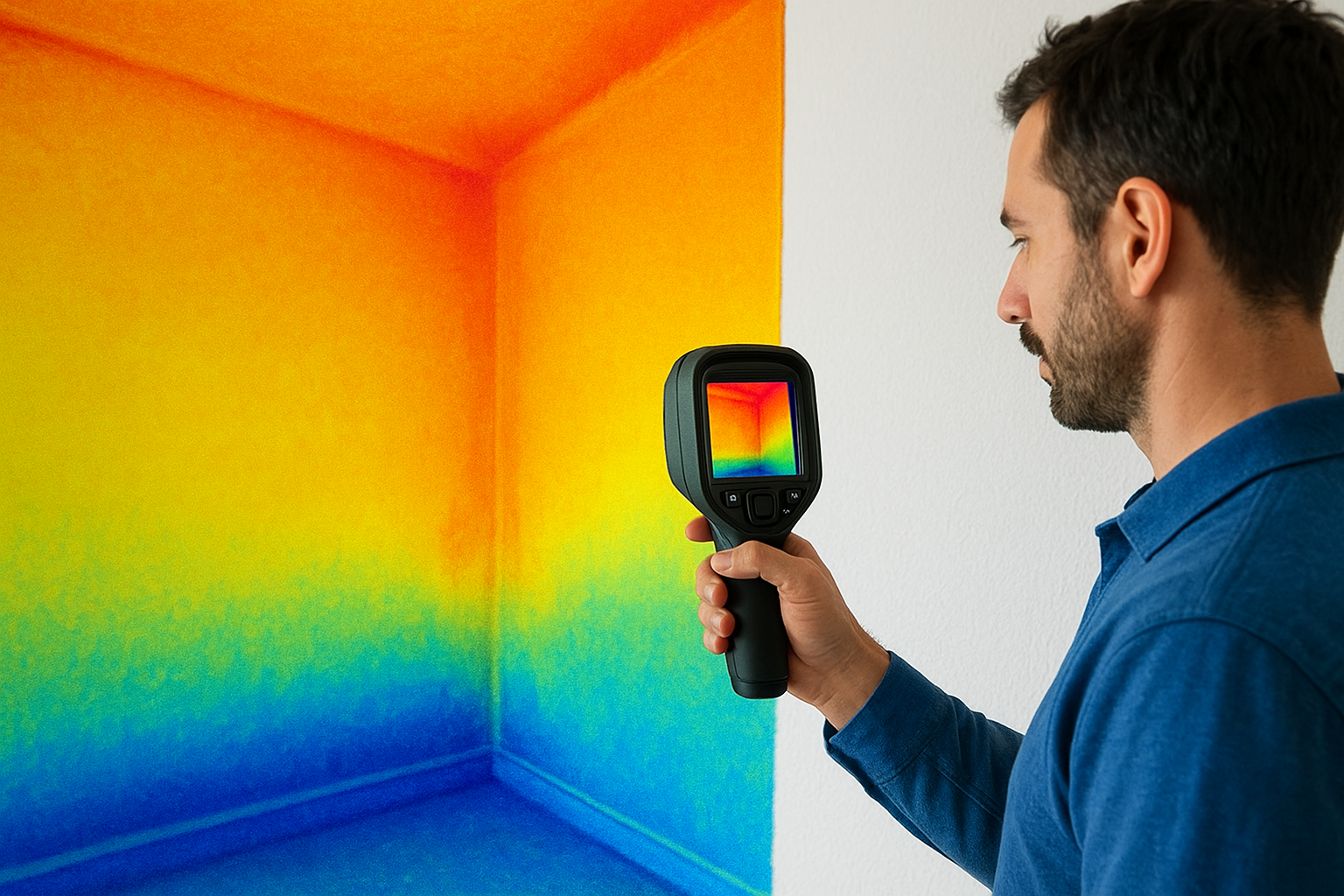
Every object with a temperature above absolute zero emits infrared radiation, energy that’s invisible to the naked eye. So what is thermal imaging? It’s the technology that captures that radiation and converts it into a visual map of heat, letting you literally see temperature differences across any surface or scene. From electricians scanning for overloaded circuits to paranormal investigators hunting cold spots in a reportedly haunted location, thermal imaging turns invisible data into something actionable.
At Haunt Gears, we sell and test thermal imaging devices built for paranormal investigation, so we spend a lot of hands-on time with this technology. That experience gives us a grounded perspective on how these cameras actually work, not just in ghost hunting, but across every field that relies on them.
This article breaks down the core science behind thermal imaging, explains how infrared cameras detect and display heat, and walks through its most common real-world applications. Whether you’re evaluating a thermal camera for home inspections, industrial maintenance, security, or your next investigation, you’ll leave with a clear understanding of what this technology can and can’t do.
Why thermal imaging matters
Understanding what is thermal imaging matters more now than it ever has. The cost of thermal cameras has dropped significantly over the past decade, bringing technology that was once limited to military and industrial use into the hands of homeowners, contractors, security professionals, and independent researchers. That shift means more people are using heat-based imaging to make faster decisions and avoid costly mistakes across a wide range of situations.
It catches what your eyes miss
One of the strongest cases for thermal imaging is that it detects problems that look completely normal under visible light. A wall with no visible damage might be hiding water intrusion behind the drywall, while an electrical panel that looks fine can have a dangerously overheating connection buried inside. Without thermal imaging, you’d only discover these issues after they’ve already caused damage or system failure.
Thermal imaging doesn’t just find problems earlier; it finds problems that would otherwise stay invisible until they become expensive or dangerous.
This early-detection advantage is why so many fields have adopted the technology as a standard part of their inspection process. Home inspectors use it to find moisture, insulation gaps, and HVAC leaks. Industrial facilities scan equipment to catch overheating components before a breakdown shuts down production. Wildlife researchers also rely on thermal cameras to track animals at night without disturbing them with visible light.
It works in conditions that stop other tools
Thermal imaging doesn’t depend on visible light, which means darkness, smoke, and fog don’t prevent it from producing a usable image. A thermal camera picks up heat signatures regardless of lighting conditions, making it useful for security and search-and-rescue operations where conventional cameras fail completely. That capability alone explains why law enforcement and firefighting crews treat thermal imaging as essential equipment rather than optional gear.
For paranormal investigators, this same property makes thermal cameras valuable in dark locations where activity is typically reported. Cold spots, unexplained drafts, and temperature variations across a room all become visible and documentable with the right device. Whether you’re trying to rule out a natural explanation or capture something harder to explain, thermal imaging gives you data that a standard camera simply cannot provide.
It saves money over time
The upfront cost of a quality thermal camera can feel significant, but consider what you’re actually paying for. Catching a roof leak early, identifying an overloaded circuit before a fire, or spotting failing insulation before winter heating bills spike, each of these scenarios represents real savings that far exceed the price of the camera. Across professional trades and hobbyist use alike, thermal imaging consistently proves its value by turning invisible problems into visible, solvable ones before they escalate into major expenses.
How thermal imaging works
To understand what is thermal imaging at a mechanical level, start with the physics: every object emits infrared radiation in proportion to its surface temperature. You can’t see this radiation with your eyes, but a thermal camera’s sensor picks it up with precision across an entire scene and translates it into something you can read instantly.
From heat to image
A thermal camera uses a specialized sensor called a microbolometer to capture incoming infrared radiation. Each pixel in the sensor heats up slightly when infrared energy strikes it, and the camera measures those tiny resistance changes across thousands of pixels at once. The camera’s processor then takes all that data and converts it into a color-coded temperature map you can read in real time, with warmer and cooler areas represented by distinct colors.

The key distinction here is that thermal cameras don’t need any light source at all. They read heat, not reflected light, which is why they perform equally well in pitch darkness or broad daylight.
Reading the color scale
The colors on a thermal image represent a spectrum of relative temperatures, not the actual visible colors of the objects in front of you. Most cameras default to a palette where warmer surfaces appear in reds and whites, while cooler surfaces shift toward blues and purples. You can switch color palettes depending on your task, because some palettes make subtle temperature gradients far easier to interpret than the default setting.
Calibration also shapes what you see. Quality thermal cameras adjust their output range automatically based on the temperatures present in the scene, keeping the image readable whether you’re scanning a cold exterior wall or a hot industrial motor. Setting your camera’s range correctly for the environment gives you sharper contrast and more accurate readings every time you pull the trigger.
What thermal imaging can and cannot detect
Part of understanding what is thermal imaging means knowing where the technology genuinely excels and where it falls short. Thermal cameras detect surface temperature variations with impressive accuracy, but they don’t see through walls or read internal temperatures the way some people assume. Setting realistic expectations helps you get the most out of the tool.
What a thermal camera detects
Thermal cameras reliably capture heat signatures on surfaces, making them effective for identifying moisture trapped behind walls (which cools the surface), overheating electrical components, air leaks along window and door frames, and body heat from people or animals in low-light conditions. A well-calibrated camera can distinguish temperature differences as small as 0.1 degrees Celsius across a surface, giving you detailed, actionable data in real time.
The more precisely you understand what your thermal camera captures, the more confidently you can interpret what you’re seeing.
For paranormal investigators, thermal cameras document unexplained cold spots or heat variations in a location, producing data that either rules out or confirms environmental causes like drafts, HVAC flow, or direct sunlight heating a surface over time.
What a thermal camera cannot detect
You need to respect clear limits when using thermal imaging. It reads surface temperatures only, so it won’t show you what’s happening inside a sealed wall cavity or solid object unless heat has already transferred to the surface you’re scanning. Glass presents another common blind spot, since thermal cameras can’t read through windows because glass reflects infrared radiation rather than transmitting it.
Beyond walls and glass, thermal cameras won’t detect chemicals, gases, structural cracks, or anything that lacks a measurable temperature difference at the surface level. If two objects share the same surface temperature, the camera won’t distinguish them at all, which is why pairing thermal imaging with other inspection tools gives you a far more complete picture of what’s actually happening.
Common uses of thermal imaging
Once you understand what is thermal imaging and how it detects heat, the range of fields that rely on it starts to make sense. Thermal cameras solve one core problem across every industry that uses them: they make invisible temperature variations visible and documentable in real time. That single capability applies across sectors that look nothing alike but share the same underlying need for accurate, non-invasive data.
Building and home inspection
Home inspectors and contractors use thermal cameras to find problems that pass undetected during a standard visual walkthrough. Moisture behind drywall cools the surface slightly and shows up as a distinct cold patch on the display, while insulation gaps and air leaks around windows and door frames appear as obvious temperature contrasts against a properly sealed wall. Common targets during a building scan include:

- Overheating electrical connections inside panels and outlets
- Water intrusion behind walls, ceilings, or around rooflines
- Missing or compressed insulation in exterior walls
- HVAC leaks along ductwork runs
A single thermal scan of a home can surface several costly issues at once, giving you a complete picture before any problem becomes a major repair.
Industrial and electrical maintenance
Facilities teams scan motors, transformers, and circuit breakers on a regular maintenance schedule to catch thermal anomalies before equipment fails. An overheating bearing or a loose electrical connection shows a clear heat signature against surrounding components, making it straightforward to prioritize repairs before a full shutdown occurs.
Consistent thermal inspections reduce unplanned downtime and extend the working life of expensive industrial equipment, which is why large manufacturing and utility operations treat routine thermal scanning as a standard maintenance task rather than an optional upgrade.
Security and paranormal investigation
Security teams rely on thermal cameras to detect body heat across large areas in complete darkness, since the sensor needs no visible light to produce a usable image. For paranormal investigators, that same capability translates directly into documenting cold spots, heat anomalies, and unexplained temperature shifts across a location without depending on ambient lighting or flashlights to capture the scene.
How to choose a thermal camera
Now that you understand what is thermal imaging and what it can realistically detect, choosing the right camera comes down to matching specific specs to your actual use case. A device built for stationary building inspections may not perform at the level you need for documenting subtle temperature anomalies across a wide, dark investigation space. Knowing the specs that matter most before you buy saves you from spending money on the wrong tool.
Resolution and thermal sensitivity
Thermal resolution determines how much detail your image actually contains. Entry-level cameras produce 80×60 pixel images, while mid-range devices offer 160×120 or 320×240 and above. Higher resolution makes it far easier to pinpoint the exact source of a heat signature rather than identifying a general zone.
Thermal sensitivity, listed as NETD, tells you the smallest temperature difference the camera can detect. Look for a rating of 0.1°C or lower if you need precise readings for inspection work or for documenting subtle environmental variations during a field investigation.
The lower the NETD rating, the finer the temperature detail your camera captures across an entire scene.
Temperature range and refresh rate
Two additional specs directly shape how useful the camera is under real conditions. Temperature range defines the surface temperatures the device reads accurately, and a range of -20°C to 300°C covers most practical field scenarios. Refresh rate, measured in Hz, controls how smoothly the image updates as you pan across a space:
- 9Hz: reliable for stationary or slow-moving scans
- 30Hz and above: better suited for active scanning across large rooms or open areas
Build quality and connectivity
Durability matters when you’re carrying a camera through rough or unpredictable environments. Look for a rugged housing that handles drops and temperature swings during extended use in the field. Also confirm whether the device connects to your smartphone or tablet via USB-C or Wi-Fi, since that integration makes capturing, labeling, and sharing data significantly faster when you’re working on site.

Key takeaways
Thermal imaging is the technology that captures infrared radiation from surfaces and converts it into a color-coded heat map you can read in real time. Understanding what is thermal imaging means recognizing both its strengths and its limits: it reads surface temperatures with precision but won’t show you what’s happening inside sealed materials or through glass.
Your choice of thermal camera depends on matching resolution and thermal sensitivity to your actual use case, whether that’s building inspections, industrial maintenance, security, or documenting unexplained temperature shifts during a paranormal investigation. Each application rewards a device spec’d correctly for the environment.
If you’re ready to put thermal imaging to work in the field, browse our professional paranormal investigation gear to find a thermal camera built for real investigative work and start capturing reliable heat data on your next session.
Discover more from Haunt Gears
Subscribe to get the latest posts sent to your email.

2 Comments
Leave your reply.