
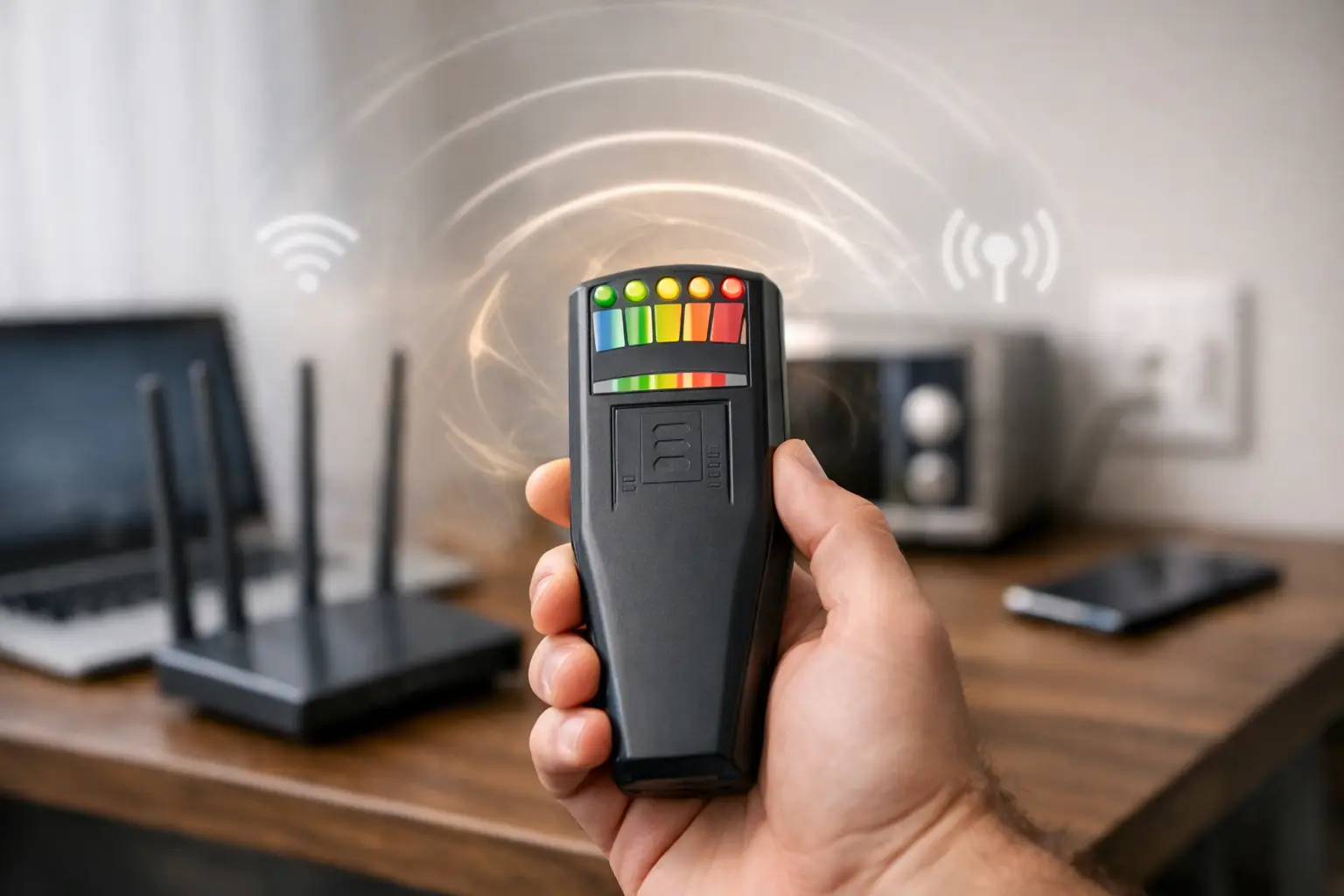
If you are building a serious paranormal investigation kit, one question comes up fast: what is emf detector equipment actually measuring, and why does it matter in the field? A lot of new investigators treat EMF tools like simple ghost alarms. That is where bad data starts. An EMF detector is a device that measures electromagnetic fields, and in paranormal work, its value comes from helping you document environmental changes that may deserve further investigation.
That distinction matters. EMF detectors do not prove a haunting. They measure electrical and magnetic energy in the area around the device. Used well, they can help you identify unusual fluctuations, map contamination from wiring or appliances, and reduce the chance of mistaking a normal source for paranormal activity. Used poorly, they create noise, confusion, and dramatic but meaningless readings.
What is an EMF detector?
An EMF detector is an instrument designed to sense electromagnetic fields generated by power lines, electronics, appliances, wiring, radios, and other energy sources. Depending on the model, it may detect magnetic fields, electric fields, or radio frequency energy. In paranormal investigation, most people are referring to handheld EMF meters that react to low-frequency fields commonly found in indoor environments.
The basic idea is straightforward. If an area shows a field spike with no obvious source, investigators may flag that moment and compare it against other evidence such as audio, temperature changes, trigger object movement, or witness reports. The detector is not there to make the case by itself. It is there to add one measurable layer to the investigation.
That is why disciplined teams treat EMF as context, not proof. A reading only becomes useful when you can compare it to a baseline and rule out ordinary causes.
How an EMF detector works in real use
Most EMF detectors use an internal sensor coil or circuit to detect changes in electromagnetic energy. When the field strength increases, the unit displays that change through lights, numbers, sound alerts, or a needle-style gauge. Some are simple single-axis meters. Others are tri-axis models that read fields across multiple directions, which usually gives more consistent results when you are moving through a location.
In practical terms, the device is picking up energy emitted by nearby sources. That source could be a breaker panel behind the wall, a refrigerator cycling on, a cell phone in your pocket, or a power cable under the floor. It could also be a transient fluctuation with no obvious explanation. The point of the tool is to help you notice, record, and investigate those changes rather than guess.
For ghost hunting, this is why technique matters so much. If you sweep a room without checking for normal electrical sources first, your detector may look active everywhere. That does not mean the location is haunted. It usually means the location is wired, powered, and full of modern devices.
What EMF detectors measure and what they do not
This is where many beginner investigations go off track. An EMF detector measures electromagnetic fields. It does not measure spirits, intent, danger, or supernatural presence. Any claim beyond field detection is interpretation.
Some meters focus on extremely low frequency fields, especially from household current and nearby electronics. Others are built to detect broader ranges, including radio frequency energy. For paranormal use, the common handheld meters are usually chosen for quick field checks, hotspot identification, and simple alert-based monitoring.
What they do not do is explain the source on their own. A high reading tells you something is present electrically or magnetically. It does not tell you whether that source is old wiring, a hidden transformer, a walkie talkie, or something genuinely anomalous. That is your job as the investigator.
Why EMF detectors are popular in paranormal investigation
EMF detectors are popular because they are easy to carry, fast to read, and useful in baseline work. They also fit the larger goal of turning subjective experiences into documented observations. If a witness reports feeling uneasy in one corner of a room and your meter repeatedly spikes there, you have a lead worth testing.
They are also practical for eliminating false positives. Before you start an EVP session or set up static cameras, an EMF sweep can show whether the area is being influenced by heavy wiring, routers, circuit boxes, or hidden electronics. That helps you choose cleaner locations for audio and video collection.
Another reason they remain common is that many reported paranormal events involve sudden environmental changes. Investigators use EMF tools to see whether those moments coincide with measurable fluctuations. Again, that correlation is not proof. It is a reason to keep documenting.
The biggest mistake investigators make with EMF meters
The biggest mistake is treating every spike like evidence. That approach creates weak cases and wastes time. EMF readings are highly sensitive to normal environmental conditions, especially indoors.
A detector can respond to phones, battery packs, fluorescent fixtures, Wi-Fi gear, security systems, extension cords, HVAC equipment, and even the meter being held too close to another device in your own kit. If you do not control for those factors, your readings are not reliable enough to support any serious claim.
The better approach is slower and less exciting, but far more credible. Establish a baseline first. Walk the location with the meter before the active session begins. Note stable high-read areas, dead zones, and spots affected by building systems. Then, during the investigation, compare any new spike against that baseline and against other gear logs.
What is EMF detector baseline testing?
Baseline testing is the process of measuring the normal electromagnetic environment of a location before you start interpreting changes. In a paranormal investigation, this is one of the most important uses of an EMF detector.
Start by checking every room under regular conditions. Test near outlets, fuse boxes, appliances, televisions, lamps, routers, and known wiring paths. If the building is older, expect inconsistent wiring and stronger contamination in some areas. If the site is commercial, watch for hidden systems in walls and ceilings.
Once you know what normal looks like, unusual readings become easier to evaluate. Without a baseline, you are not investigating. You are reacting.
Choosing the right EMF detector for ghost hunting
Not every EMF meter is equally useful for paranormal work. Some are built more for general safety checks or home inspection, while others suit mobile field investigations better. The right choice depends on how you investigate.
If you want simplicity, a basic meter with clear visual alerts can work well for walkthroughs and trigger sessions. If you want cleaner data, a model with numeric readouts and better range detail is usually the better investment. Tri-axis meters are often preferred by more methodical teams because they reduce the need to orient the device perfectly during a sweep.
The trade-off is cost versus clarity. A simple alert-style device is easy to use and quick to train on, but it can encourage overreaction. A more detailed meter gives you better information, but only if you are willing to learn what the numbers mean and document them correctly. For investigators trying to build a more disciplined kit, that extra detail is often worth it.
How to use an EMF detector without contaminating your evidence
Keep the meter away from your phone, radios, battery banks, and camera transmitters. If your team uses walkie talkies, test their interference range before the session begins. Do not assume your own equipment is neutral.
Use the detector with a notebook, voice log, or timestamped video. If a spike happens, record where you were, what nearby devices were active, and whether anything else occurred at the same moment. A reading with context is useful. A reading with no record is just a memory.
It also helps to avoid chasing the meter around the room. If you get a notable fluctuation, stop and test the area carefully from multiple positions. Repeatability matters. If the same result appears under similar conditions, it deserves more attention.
For teams looking to improve equipment discipline, resources at Haunt Gears can help compare meter types and build a kit around documented field use rather than hype.
When an EMF reading is actually worth paying attention to
A meaningful reading is one that stands out from baseline, cannot be easily tied to a normal source, and ideally occurs alongside other relevant data. That could be a repeated spike in a location with no active power source, or a fluctuation that coincides with an audio anomaly, witness experience, or movement on camera.
Even then, caution matters. One unexplained reading is still just one data point. Strong investigations come from patterns, repeat tests, and multiple forms of documentation.
That is the real answer to what is emf detector use in paranormal research. It is not a shortcut to proof. It is a measurement tool that helps serious investigators separate environmental facts from assumptions. If you treat it that way, it becomes one of the most useful pieces of gear in your case workflow. The smartest investigators do not ask the meter to tell them what happened. They use it to ask better questions.
Discover more from Haunt Gears
Subscribe to get the latest posts sent to your email.

Leave a Reply
Your email is safe with us.