
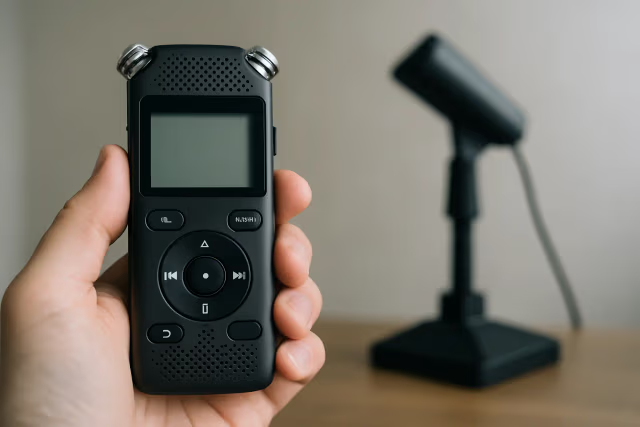
You hit record in a quiet hallway. Your team asks a few clear questions. Nothing unusual happens – at least not in the moment. Then later, on headphones, you catch a faint reply tucked between your words. That exact experience is why EVP recorders are still a core tool in serious paranormal kits.
An EVP recorder is not a magic box that “pulls spirits through.” It’s a purpose-built way to capture audio you can review, isolate, and document as potential electronic voice phenomena (EVP). Used well, it turns a chaotic night into something you can actually analyze.
What is an EVP recorder?
An EVP recorder is a digital audio recorder used during paranormal investigations to capture sound in the environment, with the specific goal of documenting possible anomalous voices or responses that were not clearly heard live.
In practice, it’s a workflow tool. You’re creating a time-stamped audio record of:
- What questions were asked and when
- What natural sounds were present (footsteps, HVAC, traffic, wildlife)
- Any potential responses that might only show up during playback
That last point is the reason EVP is a “review later” method. Most compelling clips are noticed after you’ve left the location – when you can replay the same few seconds, slow it down, compare it to another device, and decide whether it’s truly odd or just audio behaving like audio.
How EVP recorders work in the field
At a basic level, an EVP recorder uses a microphone to convert air vibrations into an electrical signal, then saves that signal as a digital audio file. That part is normal audio tech. What matters for investigating is how the device handles real-world conditions: low-level sounds, sudden peaks, background rumble, and the way it compresses or cleans up audio.
Most investigators use an EVP recorder in one of two modes.
Active sessions
This is your classic question-and-response setup. You announce the date, time, location, and who’s present. You ask short, specific questions, then leave space for potential replies. A good habit is to speak clearly and avoid stacking questions back-to-back. You’re not just hoping for a voice – you’re creating gaps where a voice could be detected without fighting your own talking.
Passive recording
You place the recorder in a room and let it run while you investigate elsewhere or while everyone stays quiet. Passive recording is great for reducing contamination from your own voices, but it introduces a trade-off: it’s easier for normal building sounds to feel “mysterious” when you weren’t there to hear them live.
What an EVP recorder is not (and why that matters)
If you’re shopping, the fastest way to avoid disappointment is to separate EVP recording from spirit box style methods.
An EVP recorder is meant to capture the environment as-is. A spirit box scans radio frequencies or uses noise sources to create a raw audio bed some investigators believe entities can manipulate. That’s a different method with a different evidence problem – namely, it’s much harder to rule out normal audio sources.
With EVP recording, the evidence standard can be cleaner: the device is simply recording the room. Your job is then to control variables so the recording can be evaluated with a straight face.
The features that actually affect evidence quality
You’ll see a lot of marketing fluff in the recorder space. For investigations, a handful of specs and behaviors make the real difference.
Microphone sensitivity and noise floor
A sensitive mic can capture quieter details – good for faint whispers, bad for every tiny rustle of clothing. The noise floor is the device’s baseline hiss. A lower noise floor gives you more usable quiet space before everything turns into shhhhhh.
If you’ve ever boosted volume on a file and heard a wall of static, you’ve run into a noise floor problem.
File format and compression
Uncompressed or lightly compressed formats preserve detail better. Highly compressed audio can smear consonants and create digital artifacts that sound like syllables. That’s a big deal in EVP work, where one clipped “s” can turn “stay” into “say.”
You don’t need studio perfection, but you do want a recorder that doesn’t chew up the exact frequencies you’re trying to evaluate.
Gain control and automatic leveling
Some recorders use automatic gain control (AGC) that constantly turns the volume up in quiet moments and down when something loud happens. AGC is convenient, but it can also “pull up” background noise in the pauses – which is precisely where you’re listening for EVP.
Manual control gives you consistency. AGC gives you ease. Which is better depends on your investigation style and your tolerance for post-review confusion.
Handling noise and build
If you’re holding the recorder during a session, the body design matters. Cheap plastic shells, loose battery doors, and clicky buttons can create sounds that mimic taps or knocks on playback. A recorder that’s quiet in your hand is underrated.
Battery life and storage
This is less exciting, but it’s how investigations fail. Long sessions drain batteries fast, and full storage means you stop recording without noticing. Look for predictable run time, easy file management, and a clear battery indicator you can trust.
Recorder vs phone: can you just use what you already have?
You can capture interesting audio on a smartphone. Plenty of investigators have. But phones come with built-in problems that show up the moment you try to treat the audio as evidence.
Phones often apply aggressive processing meant for speech clarity on calls or videos. They may filter noise, compress dynamics, and “improve” audio in ways you can’t fully control. They also pick up handling noise because you’re usually touching the device, and notifications can ruin a clean session.
A dedicated EVP recorder is simpler and more honest about what it’s capturing. That doesn’t mean it guarantees results. It just makes your recording more consistent and easier to defend when someone asks, “Could your device have created that?”
How to run an EVP session that holds up under review
You don’t need a ritual. You need discipline.
Start by setting the scene on tape. State the location, date, time, and who is present. If you’re filming, say that too. Then do a quick environmental check: are there trains nearby, a TV in another room, a refrigerator cycling, a dog outside? Say it out loud. When you hear that sound later, you’ll know it wasn’t a “voice.”
Keep questions short and testable. “What is your name?” beats “Are you stuck here because of the tragedy that happened in 1892?” Leave a consistent pause, often 10-20 seconds, depending on your patience and how quiet the location is.
Most importantly, control your own noise. Don’t whisper over each other. Don’t shuffle. If you cough, say “cough” immediately after. It feels silly, but it saves hours of second-guessing.
Playback and review: where EVP actually happens
If the field session is the capture, the real work is review.
Use headphones you trust. Play the clip at normal speed first. If something stands out, replay the same time segment a few times without changing settings. Then, and only then, try small adjustments like slight EQ or volume gain. Heavy processing can manufacture clarity that wasn’t there.
The best habit is cross-checking. If you ran a second recorder, or if a camera mic was rolling, compare the same moment. If the “voice” appears on multiple devices at the same timestamp, it becomes harder to dismiss as a device artifact. If it only appears on one device and only after aggressive boosting, treat it as “interesting” rather than “confirmed.”
Common false positives (and how to avoid them)
EVP work attracts false positives because the human brain is wired to find patterns in noise. That doesn’t mean you’re imagining everything. It means you should build guardrails.
Room acoustics can bend ordinary sounds into something voice-like. HVAC and distant traffic create rhythmic textures that can mimic syllables. Clothing movement, finger taps, and cable bumps can sound like knocks. And if you’re in an older building, natural settling creaks can line up with your questions in ways that feel personal.
The fix is boring but effective: document environmental sounds, keep the recorder stable, and run controlled silence tests. Record 60 seconds of quiet with no questions. If “voices” appear constantly in pure silence, you may be hearing noise floor artifacts or AGC pumping.
Choosing the right EVP recorder for your style
The “best” recorder depends on how you investigate.
If you do handheld Q-and-A, prioritize low handling noise, simple controls, and stable gain behavior. If you prefer room drops, focus on battery life, storage, and a mic that performs well at a distance. If you create content, you may care more about file transfer speed and how easily the audio syncs with video.
Budget matters too. Entry-level recorders can absolutely capture usable audio, but you may spend more time sorting through hiss, compression artifacts, or weird auto-level behavior. Higher-end units often buy you cleaner raw files and fewer “maybe it’s the device” moments.
If you want a decision-first path, HauntGears (https://Hauntgears.com) organizes EVP recorders alongside the rest of a practical investigation kit, so you can match audio tools to the way you actually run cases.
Closing thought
Treat an EVP recorder like a witness that never blinks. The more disciplined your session, the more confident you’ll be later – not just that you captured something strange, but that you captured it in a way you can stand behind.
Discover more from Haunt Gears
Subscribe to get the latest posts sent to your email.

Leave a Reply
Your email is safe with us.