
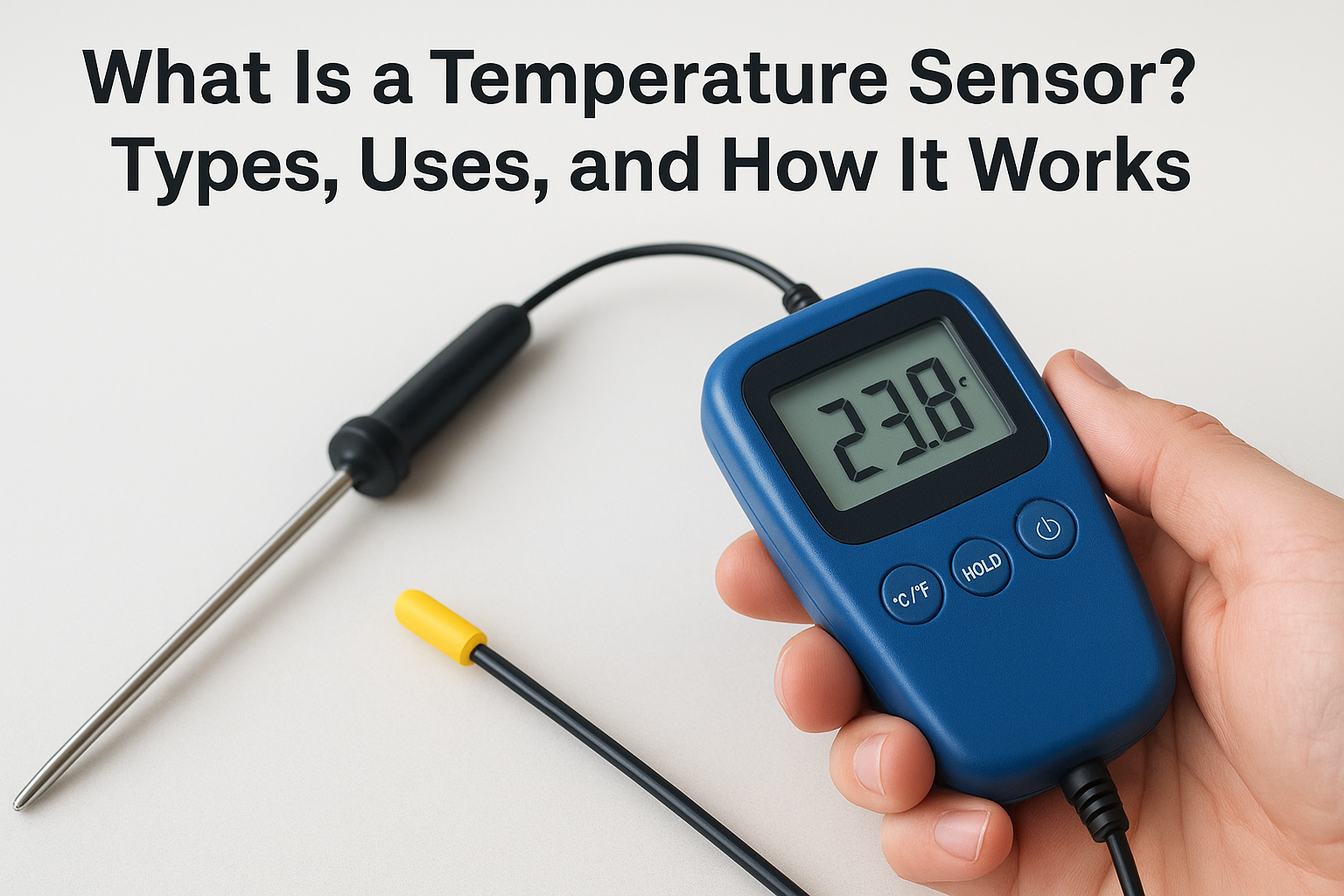
A sudden, unexplained drop in temperature is one of the most commonly reported signs of paranormal activity. But to detect and document it, you need to understand the technology behind the reading. So, what is a temperature sensor? At its core, it’s a device that measures changes in heat or cold within an environment and converts that data into a readable output. For paranormal investigators, this isn’t just trivia, it’s foundational knowledge for choosing the right gear.
Temperature sensors are built into many of the tools we sell and review here at Haunt Gears, from thermal imaging cameras to ambient thermometers used during active investigations. Knowing how these sensors function, what types exist, and where they’re applied gives you a real advantage when you’re evaluating equipment or interpreting evidence in the field. It’s the difference between trusting your readings and second-guessing them.
This article breaks down the core principles behind temperature sensors, walks through the main types you’ll encounter, and covers their practical applications, both in everyday technology and in paranormal research. Whether you’re building your first kit or upgrading your loadout, this is the technical groundwork worth having. Let’s get into it.
Why temperature sensors matter
Temperature sensors are present in more places than most people realize. Your smartphone uses one to prevent overheating. Your car’s engine management system relies on one to stay within safe operating ranges. Industrial facilities, hospitals, food storage units, and HVAC systems all depend on accurate temperature data to function properly and safely. Understanding what is a temperature sensor helps you see just how deeply this technology is embedded in both everyday infrastructure and specialized fields like paranormal investigation.
Accurate temperature data is only valuable when you understand what the sensor is actually measuring and what can interfere with it.
In everyday technology
Temperature sensors keep the devices and systems you use daily running within safe limits. In consumer electronics, they prevent your laptop or phone from overheating by triggering cooling fans or issuing shutdown warnings before heat causes permanent damage. In medical and food safety contexts, they enforce critical thresholds, keeping vaccines cold enough to remain effective and ensuring commercial refrigeration units hold steady, bacteria-resistant temperatures around the clock.
Here are the core areas where temperature sensors show up in everyday life:
- Electronics: Smartphones, laptops, gaming consoles, and charging hardware
- Automotive: Engine coolant monitoring, cabin climate control, EV battery management
- Healthcare: Patient monitoring systems, refrigerated medication storage, diagnostic devices
- Food and Beverage: Walk-in coolers, commercial ovens, and fermentation equipment
- HVAC and Building Systems: Smart thermostats, air handling units, and automated climate controls
Each of these applications depends on fast, reliable readings that update continuously. When a sensor fails or drifts out of calibration, the consequences range from equipment damage to genuine safety risks. Precision and reliability are non-negotiable across every one of these industries.
In paranormal investigation
For investigators, temperature sensors serve a different but equally important function: documenting environmental anomalies that direct observation alone would miss. Cold spots are among the most frequently reported phenomena during active investigations. A sudden, localized drop in ambient temperature in an otherwise stable room can be a meaningful data point, but only when you can record it accurately and in real time.
This is why so many pieces of investigative gear include built-in temperature sensors or support external probes. You’re not taking a reading just to fill a data log. You’re building a timestamped environmental record that can either support or rule out natural explanations for what you and your team experience. A drafty window, an HVAC vent, or a cold concrete foundation can all create localized cold zones. Without reliable sensor data, there’s no objective way to separate those ordinary causes from readings that genuinely warrant deeper investigation.
Your evidence is only as credible as the tools that produced it. Choosing gear with properly calibrated temperature sensors and understanding their limitations before you walk into a location is one of the most practical steps you can take to run a tighter, more defensible investigation.
How temperature sensors work
Understanding what is a temperature sensor is straightforward once you see the underlying mechanism. Every temperature sensor operates on the same basic principle: it detects a physical or electrical property that changes predictably in response to heat and converts that change into a measurable output. The specific property being tracked varies by sensor type, but the goal is always the same: translate a temperature shift into a number you can read and record.
From physical change to readable output
The material inside the sensor responds to heat in a consistent, repeatable way. In some sensors, electrical resistance changes as temperature rises or falls. In others, two dissimilar metals bonded together generate a small voltage difference whenever there’s a temperature gap between their junction points. Infrared sensors take a different approach entirely, reading the thermal radiation that all objects emit without making physical contact with the surface at all. Each method has different strengths in terms of range, speed, and accuracy.

Here’s a simplified look at how the core conversion process works:
- The sensor material encounters a temperature change in the environment
- A measurable electrical property shifts in direct proportion to that change
- The sensor’s internal circuit converts that shift into a standardized signal
- That signal reaches a display, data logger, or connected device as a readable temperature value
Signal processing and output
Once the sensor generates a signal, the connected hardware interprets it and converts it into the temperature unit you see on your screen. Most modern sensors output data in analog or digital formats, and the devices they connect to are designed to handle one or both. For paranormal investigators, this matters because it determines how quickly your equipment registers a change and how granular the captured data actually is. A sensor with a slow response time or low resolution can miss a brief temperature anomaly entirely, which is exactly the kind of reading you’re in the field to catch.
A sensor that responds slowly or rounds readings to the nearest degree can erase the precise detail that makes your evidence credible.
Types of temperature sensors and when to use each
Once you understand what is a temperature sensor at the functional level, the next step is knowing which type fits your situation. Sensor design determines measurement range, response speed, and the kind of environment it can handle reliably. Picking the wrong type doesn’t just affect accuracy; it can mean missing critical data entirely, which is a real problem when you’re trying to document something that may only last a few seconds.
Contact-based sensors
Contact-based sensors require physical contact with a target surface or surrounding air to take a reading. The three most common designs are thermocouples, RTDs, and thermistors, and each one occupies a different position in terms of range and precision.
Thermocouples handle extreme temperature ranges, making them the standard choice in automotive and industrial settings. RTDs (Resistance Temperature Detectors) deliver higher accuracy across a narrower range, which suits lab environments and medical equipment where tight tolerances matter. Thermistors respond quickly to small temperature changes, so they show up frequently in consumer electronics and HVAC systems where fast, reliable feedback is the priority.
Choosing between these three comes down to one question: do you need wide range, high precision, or fast response?
For paranormal investigators using ambient thermometers or probe-style sensors, thermistors are the most common underlying technology. They pick up localized shifts quickly, which is exactly what you need when you’re documenting a potential cold spot during an active investigation.
Non-contact infrared sensors
Infrared sensors measure thermal radiation emitted from a surface without making direct contact with it. This design makes them ideal for scanning large areas quickly or reading surfaces you can’t safely reach or touch.

Thermal imaging cameras used in paranormal investigation rely on this technology to display temperature variation across an entire field of view in real time. You can identify cold zones, warm anomalies, and gradients that a contact sensor placed at a single fixed point would completely miss. For field work, infrared sensors give you spatial context that no other sensor type can match.
How to choose and use a temperature sensor
Knowing what is a temperature sensor is only half the equation. Matching the right sensor type to your environment and investigation goals is where that knowledge becomes practical. A sensor that performs well in a climate-controlled lab may respond too slowly or drift in accuracy inside a cold, damp basement or an outdoor location with shifting wind. Define your investigation environment first, then evaluate gear accordingly.
Match the sensor to your application
Your primary consideration should be response time versus measurement range. If you need spatial coverage across an entire room, a thermal imaging camera with an infrared sensor is the right choice. If you’re monitoring a fixed point like a doorway or corner, a thermistor-based ambient probe delivers faster, more granular readings at that exact location. Many experienced investigators run both tools simultaneously during a session.
Pairing a thermal camera for wide scans with a fixed probe for point monitoring gives you coverage that neither tool can provide alone.
Check the measurement resolution in the product spec sheet before you buy. A sensor that resolves only to 1-degree increments can miss subtle temperature shifts that a 0.1-degree resolution device would log clearly, and that difference matters when you’re trying to document a brief, localized anomaly.
Calibrate and test before you investigate
Never assume a new sensor reads correctly out of the box. Run a baseline comparison at a known reference temperature, such as a glass of ice water at 32°F, and cross-check against a second device to identify any drift. Follow these steps before every investigation:
- Confirm the sensor reads accurately at a known reference point
- Cross-reference with a second device to catch calibration drift
- Log your baseline results with a timestamp before entering the location
- Recheck after the investigation to see if readings shifted during the session
That pre-investigation routine gives you documented proof that your gear was functioning correctly, which strengthens the credibility of any anomalous readings you capture in the field.
Common problems and how to troubleshoot them
Even a solid understanding of what is a temperature sensor doesn’t prevent hardware from behaving unexpectedly in the field. Sensor drift, interference, and poor placement are the most frequent culprits behind bad readings, and each problem has a clear, actionable fix once you know what to look for. Catching these issues before or during an investigation protects both your equipment investment and your documented evidence.
Unexplained readings are more often a hardware problem than a paranormal one, so rule out the equipment first.
Sensor drift over time
Sensors lose calibration accuracy gradually through repeated use, exposure to humidity, and physical stress. Drift is cumulative, meaning a sensor that reads 0.3 degrees off today may read 0.7 degrees off after several more investigations. You may not notice the error session to session, but it compounds quietly across your data.
Run a calibration check before each investigation by placing the sensor in a controlled reference environment, like a sealed bag surrounded by ice water at 32°F. Compare the reading against a trusted reference device, and if the gap exceeds the manufacturer’s stated accuracy tolerance, recalibrate or replace the sensor before using it for active documentation purposes.
Interference from the environment
Placement errors and nearby heat sources cause more bad readings than actual sensor failure. Direct sunlight, HVAC vents, radiant heat from electronics, and drafts through gaps in doors or windows all create localized temperature variations that have nothing to do with paranormal activity. A sensor sitting near a cold concrete wall will log consistently low readings regardless of what is happening in the rest of the room.
Move the sensor at least three feet from any obvious heat or cold source before logging your baseline readings. If you notice erratic spikes or drops at regular intervals, check whether the HVAC system is cycling on a timer. Systematic variation tied to a mechanical cycle is almost always an environmental explanation, not an anomaly worth documenting as evidence.

Key takeaways and next steps
Understanding what is a temperature sensor gives you a concrete advantage when selecting and operating paranormal investigation gear. These devices convert physical or electrical changes into readable temperature data, and the type you use determines your measurement range, response speed, and spatial coverage. Contact sensors like thermistors work well for fixed-point monitoring, while infrared sensors give you full-room visibility in real time.
Apply what you’ve read before your next investigation. Calibrate your sensors against a known reference point, run a baseline before entering any location, and rule out environmental interference like HVAC cycles or nearby heat sources before treating a reading as anomalous. Cross-reference two devices whenever possible to catch drift early. Your evidence holds up when your gear is verified and your methodology is documented.
If you’re ready to put this knowledge to work with professional-grade equipment, browse the paranormal research devices at Haunt Gears and find gear built for serious fieldwork.
Discover more from Haunt Gears
Subscribe to get the latest posts sent to your email.



Leave a Reply
Your email is safe with us.