
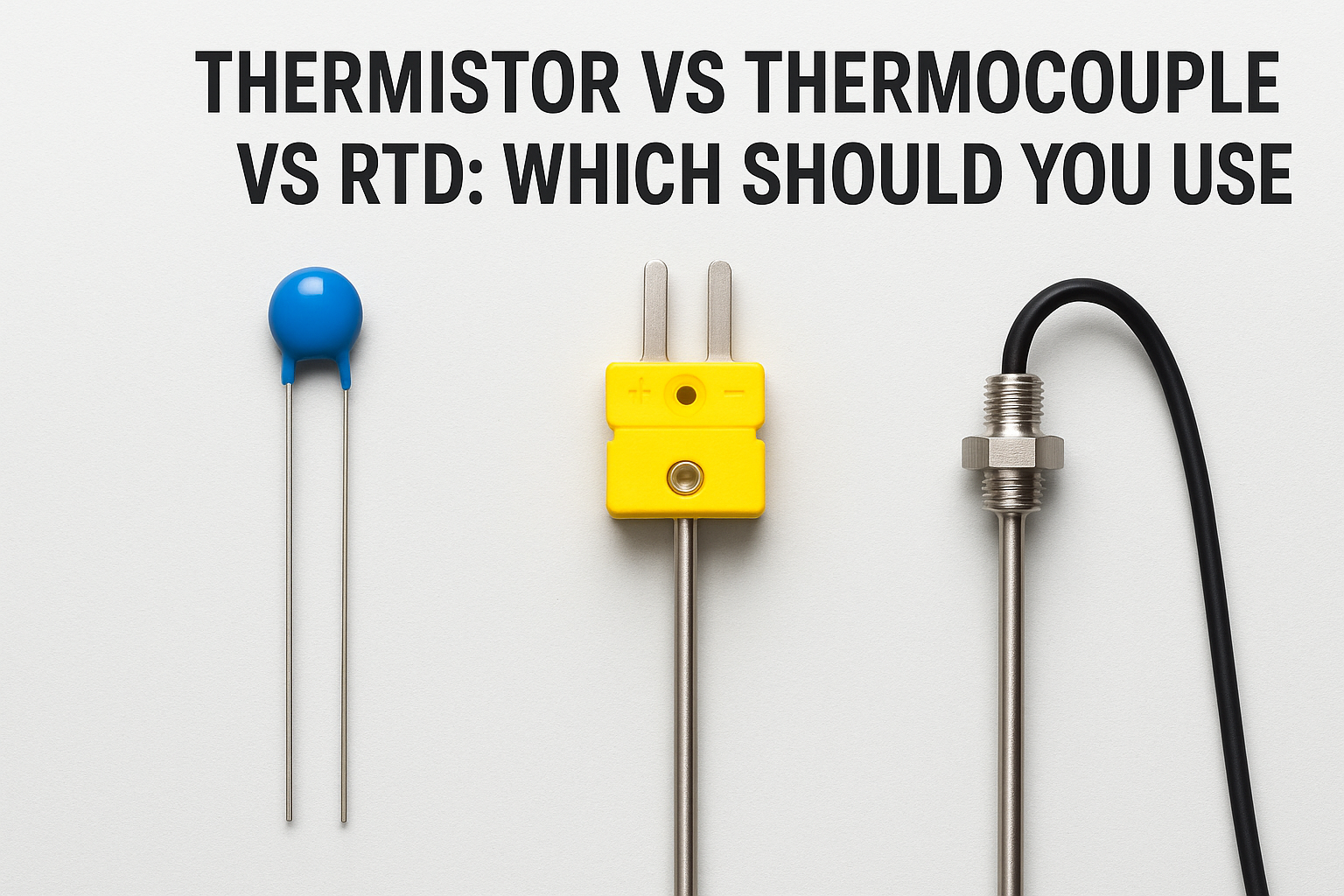
Temperature sensors sit at the core of paranormal investigation equipment, from thermal cameras that detect unexplained cold spots to environmental monitors that log sudden temperature shifts during an EVP session. But not all sensors work the same way. The debate around thermistor vs thermocouple vs RTD comes down to real engineering trade-offs that affect how accurately and reliably your gear performs in the field. At Haunt Gears, we dig into these details because the equipment you carry matters when you’re trying to document legitimate evidence.
Each of these three sensor types, thermistors, thermocouples, and RTDs (Resistance Temperature Detectors), uses a different physical mechanism to measure temperature. That means each one has distinct strengths and weaknesses in accuracy, response time, temperature range, durability, and cost. Choosing the wrong sensor for your application doesn’t just waste money; it compromises your data, whether you’re running a paranormal investigation or working in an industrial setting.
This article breaks down exactly how thermistors, thermocouples, and RTDs compare across the specs that actually matter. You’ll learn where each sensor excels, where it falls short, and which one makes the most sense for your specific use case, so you can stop guessing and start making an informed decision.
Why sensor choice matters in the field
When you pick a temperature sensor, you’re deciding how precisely and quickly your device responds to the world around it. Sensor choice directly controls measurement accuracy, response speed, and how well the hardware holds up across different environments. In paranormal investigation, a 2-degree temperature drop in an otherwise stable room can represent meaningful evidence, so a sensor that drifts or responds slowly turns real signals into noise or transforms noise into false positives.
The thermistor vs thermocouple vs RTD comparison has direct consequences for the gear you rely on. Each sensor type shows up in specific equipment categories, and understanding these trade-offs helps you evaluate what you already own, not just what you plan to buy next. A thermal detector built around the wrong sensor type isn’t just less accurate; it’s actively misleading in situations where precision determines whether your evidence holds up. Knowing what’s inside your equipment puts you in a stronger position to interpret your results honestly.
Sensor accuracy isn’t just a technical spec; it determines whether your evidence stands up under scrutiny.
Accuracy and response time define your evidence quality
Measurement accuracy differs significantly across all three sensor types. RTDs deliver the highest accuracy, typically within ±0.1°C under controlled conditions. Thermistors perform well within a narrow temperature band, while thermocouples are the least precise but handle the widest temperature range. If your investigation equipment advertises high sensitivity to cold spots, the sensor inside that device sets the actual ceiling on that claim. No software calibration fully compensates for a sensor that was never precise to begin with.
Response time is the other side of that equation. Thermistors respond fastest among the three types, which helps capture rapid, localized temperature shifts as they happen. Thermocouples also respond quickly, while RTDs are noticeably slower due to their construction. A slow-responding sensor in a dynamic environment means your readings describe what already happened, not what’s happening now. For real-time documentation during an active session, that lag can be the difference between capturing an event and missing it entirely.
Range, cost, and durability shape your gear selection
Thermocouples cover the broadest temperature range, from roughly -200°C to over 2,300°C. RTDs handle a moderate range with excellent stability, and thermistors max out at around 150°C. For standard indoor investigations, thermistors and RTDs both cover everything you need. If you work in harsh outdoor environments or near industrial sites, thermocouple-based gear becomes the practical choice because it handles conditions the other two sensor types simply cannot sustain.
Cost scales with performance across all three options. Thermistors are the cheapest, which explains why they dominate consumer-grade paranormal gear. RTDs cost more but deliver better long-term stability and repeatability. Thermocouples sit in the middle for price and lead the group on raw durability in extreme conditions. If you invest in high-quality investigation equipment and use it regularly across varied environments, knowing the sensor type inside helps you anticipate where the device will eventually fail, letting you plan replacements before a critical session rather than discovering the problem in the middle of one.
How thermistors, thermocouples, and RTDs work
Each sensor type exploits a different electrical property to track temperature changes. Understanding the underlying mechanism of each one connects the spec sheet numbers to real-world performance. The thermistor vs thermocouple vs RTD comparison becomes much clearer once you see how each device actually does its job.

How thermistors work
A thermistor is a resistor made from semiconductor material whose resistance changes sharply in response to temperature. As temperature rises or falls, the resistance shifts along a predictable, nonlinear curve. Most thermistors are NTC (negative temperature coefficient) types, meaning resistance drops as temperature increases.
Because thermistors produce a large resistance change per degree, they deliver high sensitivity within a narrow range, typically between -50°C and 150°C. That sensitivity is why consumer-grade paranormal detectors use them; they catch small temperature shifts quickly without requiring expensive signal processing hardware.
How thermocouples work
A thermocouple generates a small voltage by joining two dissimilar metals at a point called the hot junction. When that junction heats or cools, it creates a measurable voltage difference relative to a reference junction. No external power source is required because the voltage comes directly from the temperature differential itself.
The voltage output from a thermocouple is tiny, typically in the millivolt range, so your measurement device must amplify and interpret it correctly to produce a useful reading.
This self-powered design makes thermocouples rugged and mechanically simple, which explains their use in industrial equipment and outdoor field devices where reliable performance across a wide temperature range matters more than pinpoint accuracy.
How RTDs work
An RTD measures temperature through the predictable, linear increase in electrical resistance of a pure metal, almost always platinum, as temperature rises. Unlike thermistors, the resistance change is linear, which makes calibration straightforward and long-term measurement stability easier to maintain.
RTDs require an external current source to measure resistance, which introduces a small self-heating effect that can skew readings if not managed properly. High-quality RTDs use four-wire configurations to eliminate lead resistance errors and keep your measurements consistently precise over time.
Key differences at a glance
The thermistor vs thermocouple vs RTD comparison becomes concrete when you line up the specs side by side. Each sensor type makes a distinct set of trade-offs across accuracy, range, sensitivity, response time, and cost. The table below captures those differences so you can quickly identify which sensor fits your needs without wading through datasheets.

| Spec | Thermistor | Thermocouple | RTD |
|---|---|---|---|
| Accuracy | ±0.1°C to ±1°C | ±0.5°C to ±2°C | ±0.1°C to ±0.5°C |
| Temperature Range | -50°C to 150°C | -200°C to 2,300°C | -200°C to 600°C |
| Response Time | Fast | Fast | Slow |
| Sensitivity | High (narrow range) | Low | Medium |
| Cost | Low | Low to Medium | Medium to High |
| Linearity | Nonlinear | Nonlinear | Linear |
Where each sensor leads
The table shows raw numbers, but the practical implications extend well beyond specs. Thermistors win on sensitivity and cost, which explains why consumer-grade paranormal gear relies on them so heavily. They catch small temperature shifts quickly, but that advantage disappears above 150°C or when you need consistent readings across a wide range. For indoor investigations in controlled environments, a thermistor-based device handles the job cleanly.
Thermocouples trade accuracy for extraordinary temperature range and mechanical durability. Most paranormal work never pushes into extreme temperatures, but if you investigate outdoor or industrial locations, a thermocouple holds up where the other two sensor types fail. Their accuracy limitations mean you should treat thermocouple readings as directional guides rather than precise measurements when you need to document specific temperature shifts.
RTDs deliver the best long-term accuracy and linearity, making them the right choice when data quality matters more than budget.
Where cost meets performance
RTDs occupy the premium tier in this comparison. They cost more, respond slower, and need more careful circuit design, but they give you stable, repeatable measurements that hold consistent over time and across calibration cycles. Investigation gear built around RTD sensors appears less often in consumer products but shows up in professional environmental monitors where measurement integrity is non-negotiable. If you document evidence that needs to withstand scrutiny, understanding which sensor type your gear uses directly affects how confidently you can stand behind your readings.
How to pick the right sensor for your project
Choosing between a thermistor vs thermocouple vs RTD starts with one question: what does your application actually demand? Temperature range, required accuracy, and budget are the three variables that narrow the field fast. Once you answer those honestly, the comparison does most of the decision-making for you.
Match your sensor to your temperature range
Your operating environment sets the first hard boundary. If you work exclusively indoors at standard ambient temperatures, a thermistor covers the full scope of what you need. Its range of -50°C to 150°C handles every typical investigation scenario, and its fast response time means you catch sudden temperature shifts as they happen rather than reading delayed data from a sensor still catching up.
When your work takes you to outdoor sites, industrial locations, or any environment that pushes past 150°C, a thermocouple becomes the only practical option. Extreme temperature range and rugged mechanical construction make it the default choice for harsh conditions where thermistors and RTDs simply cannot operate reliably. If your gear fails in the middle of an investigation, you lose both the session and any data already collected.
If your environment stays below 150°C and you need fast, sensitive readings on a limited budget, a thermistor delivers the best performance per dollar.
Consider accuracy vs cost trade-offs
Budget shapes your decision significantly, but it should not be the only factor. A thermistor costs the least and works well for applications where sensitivity in a narrow temperature band matters more than absolute precision. It suits most consumer-grade paranormal equipment and beginner setups where upfront cost is a real constraint and indoor conditions stay predictable.
RTDs justify their higher price when you need repeatable, long-term accuracy that holds consistent across calibration cycles. If you document evidence that will face scrutiny, or you use environmental monitoring gear in professional settings, RTD-based equipment gives you data you can actually defend. Thermocouples offer acceptable accuracy at a moderate price with the added benefit of covering temperature extremes the other two sensor types cannot reach. Match your sensor to the environment you actually work in, and the right choice becomes clear.
Common pitfalls and best practices
Even when you understand the thermistor vs thermocouple vs RTD comparison well, small mistakes in how you use or set up your sensor can undermine your results. Knowing where investigators typically go wrong saves you from collecting data you cannot trust.
Avoid misreading nonlinear outputs
Thermistors and thermocouples both produce nonlinear outputs, which means your readout device must apply the correct conversion formula to translate the raw signal into an accurate temperature value. If the firmware or software in your device uses the wrong calibration curve, every reading you get will be off by a predictable but invisible margin. Always verify that the software your equipment uses matches the specific sensor model installed, especially when you replace a sensor or upgrade firmware.
A miscalibrated sensor gives you confident-looking numbers that are consistently wrong, which is worse than no reading at all.
Self-heating is another issue to watch for. RTDs require an external current to measure resistance, and that current generates a small amount of heat at the sensor itself. In a tightly enclosed housing, that heat accumulates and skews your readings upward. Using a four-wire RTD configuration and keeping probe currents within the manufacturer’s spec eliminates most of this error before it affects your data.
Handle and position your sensors correctly
Physical placement determines data quality as much as the sensor type itself. Mounting a thermistor probe near a heat-generating component inside a device housing exposes it to ambient heat from the electronics rather than the environment you’re trying to measure. Keep probes isolated from internal heat sources and position them where they can reach thermal equilibrium with the target environment quickly.
Mechanical stress and vibration degrade thermocouples and RTDs over time. Loose connections at the junction introduce resistance errors that shift your baseline reading without triggering any obvious alert. Check probe connections before each session and inspect cables for signs of wear at stress points. Consistent pre-session checks catch degradation early and protect the integrity of your data across multiple investigations.

Quick wrap-up
The thermistor vs thermocouple vs RTD comparison comes down to matching sensor strengths to your actual working conditions. Thermistors give you fast response and high sensitivity at low cost, making them the practical choice for indoor investigations where temperatures stay predictable. Thermocouples handle extreme temperature ranges and rough environments where the other two sensor types fail. RTDs deliver the best long-term accuracy and linear output when data quality carries serious weight.
Your specific environment, required accuracy, and budget determine which sensor belongs in your equipment. No single sensor type wins across every scenario, so the best choice is always the one built for the conditions you actually face. Understanding what sits inside your gear helps you interpret your readings honestly and catch problems before they corrupt your data.
Ready to upgrade your investigation setup with equipment built around reliable sensor technology? Browse the professional paranormal investigation gear at Haunt Gears and find tools matched to serious fieldwork.
Discover more from Haunt Gears
Subscribe to get the latest posts sent to your email.


Leave a Reply
Your email is safe with us.