
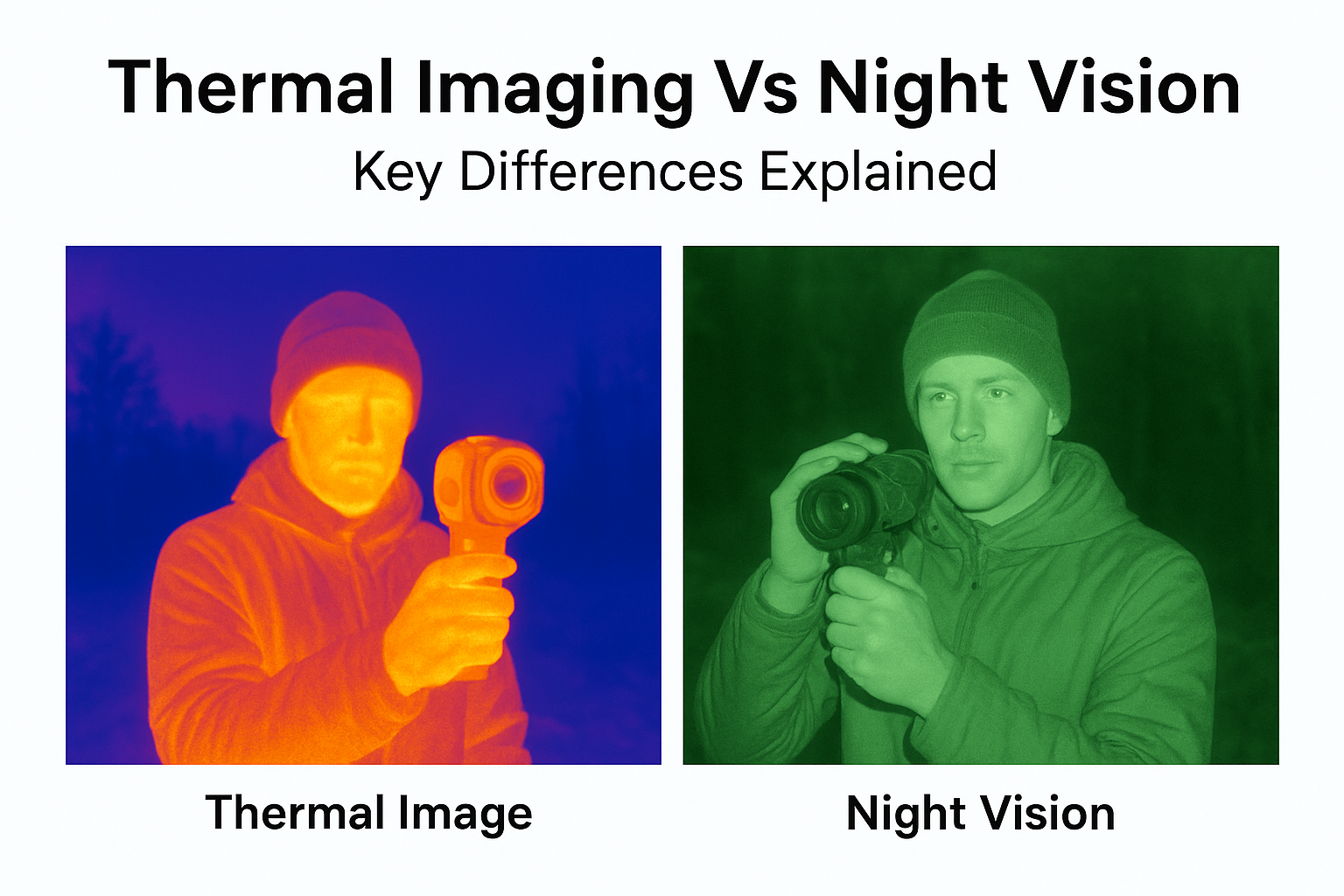
If you’ve ever tried to document activity during a nighttime investigation, you’ve likely hit the same question most ghost hunters face: thermal imaging vs night vision, which one actually belongs in your gear bag? Both technologies let you see in the dark, but they work in fundamentally different ways and capture very different types of data. Choosing the wrong one can mean missing critical evidence altogether.
At Haunt Gears, we test and review paranormal investigation equipment hands-on, and these two categories generate more confusion than almost anything else we cover. Thermal imagers detect heat signatures, useful for spotting unexplained cold spots or temperature anomalies. Night vision amplifies available light, giving you a clear visual of your surroundings in near-total darkness. Each has distinct strengths and real limitations depending on how and where you use it.
This guide breaks down the core technical differences between thermal imaging and night vision, compares their practical applications, and helps you figure out which technology fits your specific needs, whether you’re running investigations, observing wildlife, or working in tactical settings.
Why this comparison matters in low-light work
When you work in near-total darkness, the technology you carry determines what evidence you can actually capture. Most investigators assume thermal and night vision cameras deliver roughly the same result, but that assumption leads to missed recordings and hours of unusable footage. Understanding the core differences between thermal imaging vs night vision before you pack your gear is the deciding factor between a productive session and a frustrating one.
The environments that expose each technology’s limits
When conditions change, each device responds in completely different ways. Thermal cameras rely entirely on temperature contrast between objects, so they perform in complete darkness, light fog, or low-smoke environments without issue. Night vision, by contrast, needs at least some ambient light source to function, whether that’s moonlight, starlight, or a built-in infrared illuminator. If you’re investigating a fully sealed basement with zero light and no IR source, a standard night vision unit produces nothing useful regardless of how good the hardware is.
Knowing what each technology requires before you arrive at a location prevents equipment failures at the worst possible moment.
Your location type also matters beyond just light levels. Outdoor environments with wide temperature variation tend to favor thermal cameras because the contrast between a warm body and a cool background is sharp and easy to read. Indoor environments with controlled temperatures and some ambient light tend to work better with night vision, where identifying shapes and spatial details is more straightforward.
Why investigators frequently misuse both tools
Many people treat thermal and night vision cameras as interchangeable, but they record fundamentally different phenomena. A thermal camera shows you heat distribution across a scene, which is why it’s valuable for documenting cold spots and unexplained temperature shifts in paranormal work. Night vision shows you reflected or amplified light, giving you a recognizable image of the physical space with detail a thermal unit simply cannot match.
Your post-investigation review process is also affected by which tool you used. Thermal footage requires a different analysis approach because you’re interpreting temperature gradients rather than visual shapes. Investigators who switch between both tools without understanding this distinction regularly misread thermal artifacts as anomalies, which leads to inaccurate conclusions and wasted review time.
How thermal imaging works and what it shows
Thermal cameras detect infrared radiation emitted by objects, not reflected light. Every physical object with a temperature above absolute zero radiates heat, and a thermal sensor captures those emissions and converts them into a visual temperature map called a thermogram. This process requires no light source whatsoever, which is one of the key distinctions in the thermal imaging vs night vision debate.

The physics behind thermal detection
Thermal imagers use a microbolometer sensor to measure the infrared energy radiating from a scene. The sensor assigns each pixel a temperature value, and the camera’s processor converts those values into a color or grayscale image where hotter areas appear brighter and cooler areas appear darker. You’re not seeing the physical space the way your eyes would. You’re seeing a heat distribution map of everything in the frame.
A thermal camera cannot see through glass, because glass blocks infrared radiation the same way a wall blocks visible light.
What you actually see on screen
The image you get from a thermal camera is a gradient display of temperature contrast, not a detailed photograph. Sharp outlines appear only where significant temperature differences exist between adjacent surfaces. Walls, floors, and furniture often read as uniform masses unless they’re actively gaining or losing heat. For paranormal investigators, this means sudden cold zones or unexpected warm patches stand out immediately, making thermal cameras particularly useful for documenting temperature anomalies that would be invisible to a night vision unit.
How night vision works and what it shows
Night vision technology works by amplifying available light rather than detecting heat. Standard night vision devices collect existing photons from ambient sources like moonlight, starlight, or artificial light, and run them through an image intensifier tube that multiplies those photons into a usable image. Without any ambient light or a built-in infrared illuminator, a night vision unit gives you nothing to work with, which is a fundamental difference from thermal imaging vs night vision setups.
The image intensification process
Inside a night vision device, photons enter through the objective lens and strike a photocathode plate, which converts them into electrons. Those electrons then pass through a microchannel plate that multiplies their count significantly, then strike a phosphor screen that converts them back into a visible image. The generation of the device (Gen 1, Gen 2, Gen 3) determines how efficiently this process works and how clear the resulting image appears.
The green-tinted display common to most night vision devices comes from the phosphor screen, not a color filter applied to the image.
Many modern devices also include a built-in infrared illuminator that acts as an invisible flashlight, giving the sensor enough light to function even in a fully dark room.
What you actually see on screen
With night vision, you get a recognizable visual representation of the space you’re investigating, complete with depth, texture, and fine details that thermal cameras cannot produce. You can identify faces, read text on walls, and track movement with clarity. The tradeoff is that night vision shows you only what light reveals, meaning a hidden heat source or a cold draft leaves no visible trace in the footage.
Thermal vs night vision in real-world conditions
Neither device performs equally across every scenario. The real-world gap between thermal imaging vs night vision becomes obvious the moment conditions shift from the ideal. Understanding where each technology breaks down helps you avoid showing up to a location with the wrong gear for the job.

Outdoor investigations and open environments
Outdoors, thermal cameras have a clear edge in most scenarios. Wide temperature differentials between living subjects and the surrounding environment make heat signatures easy to isolate, even across large distances. Cold nights actually improve thermal contrast, so a person, animal, or unexplained heat source stands out sharply against a cool field or treeline.
Night vision works well outdoors when there is natural ambient light, but a heavily overcast sky with no artificial sources will push even a Gen 3 device to its performance limits.
Indoor and controlled spaces
Indoor use shifts the advantage in a different direction. In a heated building where wall and floor temperatures are relatively uniform, thermal cameras struggle to produce meaningful contrast, and the image can appear flat and hard to read. Night vision, on the other hand, thrives indoors because even minimal light from hallways, windows, or infrared illuminators gives the sensor enough to render a clear, detailed image.
Investigators working in locations like old hotels or historic buildings often find that night vision captures fine spatial detail such as doorframes, furniture, and stairwells that thermal cameras render as featureless masses. Running both devices simultaneously gives you the most complete record of what happened in a space.
How to choose the right option for your use
The right choice in the thermal imaging vs night vision debate comes down to what you need to document and where you plan to work. No single device covers every scenario perfectly, so matching your tool to your specific conditions saves you time, money, and frustration before you ever arrive at a location.
Choose thermal if temperature data is your priority
If your investigations focus on unexplained cold spots or heat anomalies, thermal is the stronger option. It operates in complete darkness without any light source, and it captures data that night vision simply cannot produce.
Thermal cameras are especially valuable in outdoor environments or unheated structures where temperature contrast between subjects and surroundings is naturally high.
Consider thermal imaging when any of these apply to your work:
- You investigate outdoor locations or unheated buildings where ambient temperature varies significantly
- Your evidence review focuses on documenting temperature patterns rather than visual identification
- You need a device that functions in complete darkness with zero light support
Choose night vision if visual clarity drives your work
When you need recognizable spatial detail and clear footage of movement, night vision is the better fit. It captures the physical environment in a way that thermal cameras cannot replicate, making post-investigation review far more straightforward.
Your best approach in most serious investigations is carrying both. Each device fills a gap the other leaves open, and running them together gives you a complete visual and thermal record of the session, which means no critical data slips through because you only packed one tool.

Conclusion
The core takeaway from the thermal imaging vs night vision comparison is straightforward: these two technologies serve different purposes, and treating them as interchangeable will cost you evidence. Thermal cameras capture heat data that night vision completely misses. Night vision delivers spatial clarity and visual detail that thermal units simply cannot replicate.
Your best setup combines both tools, but if you’re working with a tight budget, match the technology to your most common investigation conditions. Outdoor, unheated, or pitch-dark locations push you toward thermal. Indoor spaces with even minimal light are where night vision earns its place in your bag.
Ready to build out your kit with the right gear? Browse paranormal investigation equipment at Haunt Gears to find thermal cameras, night vision devices, and complete investigation bundles built for serious fieldwork. Carrying the right tool from the start means more usable footage and fewer missed opportunities on every investigation.
Discover more from Haunt Gears
Subscribe to get the latest posts sent to your email.

Leave a Reply
Your email is safe with us.