
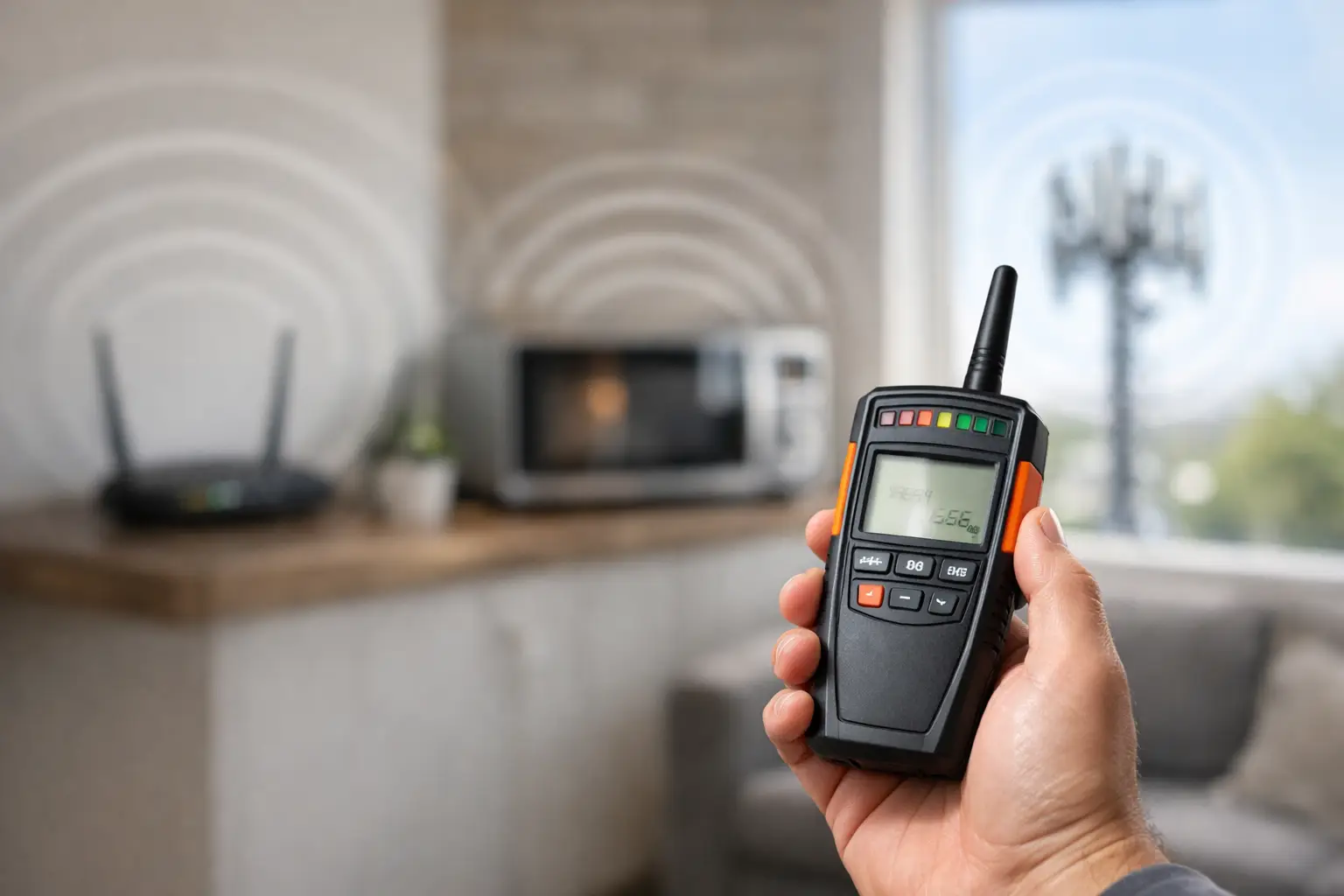
If you have ever watched an EMF meter spike in a dark room and wondered whether that means you just detected radiation, you are asking the right question. Does an EMF meter detect radiation? Sometimes yes, but not in the broad way many people assume – and that distinction matters if you are trying to run a serious paranormal investigation instead of chasing bad data.
In ghost hunting circles, “radiation” often gets used as a catchall term for anything invisible and strange. From an equipment standpoint, that is too loose to be useful. An EMF meter is designed to measure electromagnetic fields, usually low-frequency electric or magnetic fields produced by wiring, appliances, outlets, breaker panels, motors, and electronic devices. It is not a universal detector for every kind of radiation in an environment.
Does an EMF meter detect radiation in general?
Technically, electromagnetic fields are a form of radiation. That is where the confusion starts. But when most people ask whether an EMF meter detects radiation, they usually mean hazardous ionizing radiation such as alpha, beta, gamma, or X-ray exposure. A standard EMF meter is not built for that job.
That means the short answer is no – an EMF meter does not detect the kinds of radiation a Geiger counter or dosimeter is designed to detect. It measures electromagnetic activity in a specific range, generally tied to household current, nearby electronics, and other common field sources.
This is more than a wording issue. If an investigator mistakes normal EMF variation for some broad “radiation reading,” the entire interpretation can go off track. You may think you found an anomaly when you actually found an extension cord behind a wall or a mini fridge cycling on in the next room.
What an EMF meter actually measures
Most EMF meters used in paranormal work are reading one or more of these: magnetic fields, electric fields, or radio frequency fields. Which ones you get depends on the meter.
A basic single-axis or tri-axis meter usually focuses on magnetic fields, often in milligauss or microtesla. These are the models many teams carry for baseline sweeps in homes, historical buildings, and alleged hotspots. They are useful because they can show changes in the environment that deserve follow-up.
But useful is not the same as definitive. A spike only tells you that the meter sensed a change in the field strength within its designed range. It does not tell you why that change happened.
That is why disciplined investigators do baseline checks first. Sweep the room with lights on. Check outlets, lamps, routers, breaker boxes, HVAC vents, and anything battery-powered. Then document what “normal” looks like before trying to interpret a live session reading.
Low-frequency fields versus ionizing radiation
Here is the key separation. Household EMF meters are generally concerned with non-ionizing electromagnetic fields. These include the kinds of fields generated by AC wiring, power lines, phones, radios, Wi-Fi devices, and electrical equipment.
Ionizing radiation is different. It carries enough energy to remove electrons from atoms. That category includes gamma rays and X-rays, which require specialized instruments. If your goal is to detect environmental radiation hazards, an EMF meter is the wrong tool.
For paranormal teams, this matters because the instrument choice should match the question. If you want to know whether a room has fluctuating electrical fields that may affect equipment behavior or witness perception, use an EMF meter. If you want to test for radioactive contamination, use a radiation detector.
Why paranormal investigators still use EMF meters
EMF meters remain a staple in field kits because they are practical, fast, and good at identifying environmental changes that can contaminate evidence or warrant closer observation. They are not proof of paranormal activity. They are screening tools.
Used properly, they help you rule things out. If a witness reports feeling uneasy in one corner of a room and your meter shows elevated magnetic fields near an old electrical panel, that gives you a conventional explanation worth documenting. If a spike occurs in a location with no obvious electrical source, you still do not have proof of anything unusual, but you do have a data point to compare with audio, video, temperature, and witness timing.
That is the professional approach. One reading by itself is weak evidence. A pattern across multiple tools is much stronger.
Common sources of false EMF readings
A lot of bad paranormal interpretation comes from not respecting how sensitive these meters can be. Phones in a pocket, walkie talkies, hidden wiring, smart watches, power banks, and nearby investigators can all influence readings.
Even the layout of a building matters. Older locations may have inconsistent wiring, overloaded circuits, or ungrounded outlets. That can create pockets of elevated EMF that look dramatic if you have not mapped the space first.
Some consumer ghost hunting meters are also intentionally simplified. They are easy to use, but they may not tell you enough about frequency range, response time, shielding, or whether they are primarily detecting magnetic fields rather than broader electromagnetic activity. That does not make them useless. It means the user has to understand the limitations.
Does an EMF meter detect radiation from phones, Wi-Fi, or radios?
It depends on the meter. This is where the product category gets messy.
Many classic paranormal EMF meters are strongest at detecting low-frequency magnetic fields from electrical systems. They may react to nearby electronics, but they are not always ideal for measuring radio frequency exposure from Wi-Fi routers, cell phones, or wireless transmitters with much precision.
Some meters are broadband and can detect a wider range of electromagnetic activity, including RF. Others are narrow in scope. If you are buying gear for investigations, the spec sheet matters more than the label on the package.
That is one reason serious teams build layered kits rather than relying on one “all-purpose” detector. An EMF meter can cover one category of environmental measurement, while other tools handle temperature shifts, audio capture, imaging, and communication logging.
How to use an EMF meter correctly in paranormal investigations
Start with controlled conditions. Before the active session, walk the location and identify normal field sources. Note any steady high readings, intermittent spikes, and devices that cycle on and off. Refrigerators, HVAC systems, fluorescent lights, and hidden wiring are common culprits.
Then set rules for the team. Phones on airplane mode when possible. Radios used only when needed. Keep investigators spaced apart when taking readings. If one person carries a body cam, another carries a spirit box, and a third has a phone in a pocket, your EMF data can become meaningless fast.
During the session, log context with every spike. Record the time, location, meter model, baseline range, and any known environmental trigger. If something unusual happens, ask whether there was simultaneous audio, visual, thermal, or witness correlation. Without that context, a spike is just a spike.
At Haunt Gears, that evidence-first mindset is what separates a functional field kit from a pile of gadgets.
What tool should you use if you want to detect actual radiation?
If your concern is ionizing radiation, use a proper radiation detector such as a Geiger counter or dosimeter. Those tools are designed to register particle emissions or high-energy electromagnetic radiation that an EMF meter will miss.
This distinction is especially important in older buildings, industrial sites, abandoned facilities, or locations with unknown environmental conditions. A paranormal team should never treat a standard EMF meter as a safety device for radiation exposure. It is not one.
There is also a practical buying lesson here. Many beginners overspend on hype because product language blurs scientific terms. A serious investigator should ask a simple question before every purchase: what specific signal is this device designed to measure? If the answer is vague, keep looking.
The real answer investigators should remember
So, does an EMF meter detect radiation? Yes, in the narrow sense that electromagnetic fields are a form of radiation. But for the question most investigators actually mean, the answer is no – a standard EMF meter does not detect ionizing radiation and should not be treated like a Geiger counter.
What it does well is help you map electrical field conditions, identify contamination sources, and flag environmental changes worth documenting. That makes it valuable, but only when you use it with the right expectations.
Good investigations improve when every tool has a clear job. The EMF meter is there to measure field activity, not to tell the whole story for you. Use it that way, and your evidence gets cleaner, your false positives drop, and your case notes start to mean something.
Discover more from Haunt Gears
Subscribe to get the latest posts sent to your email.


Leave a Reply
Your email is safe with us.