
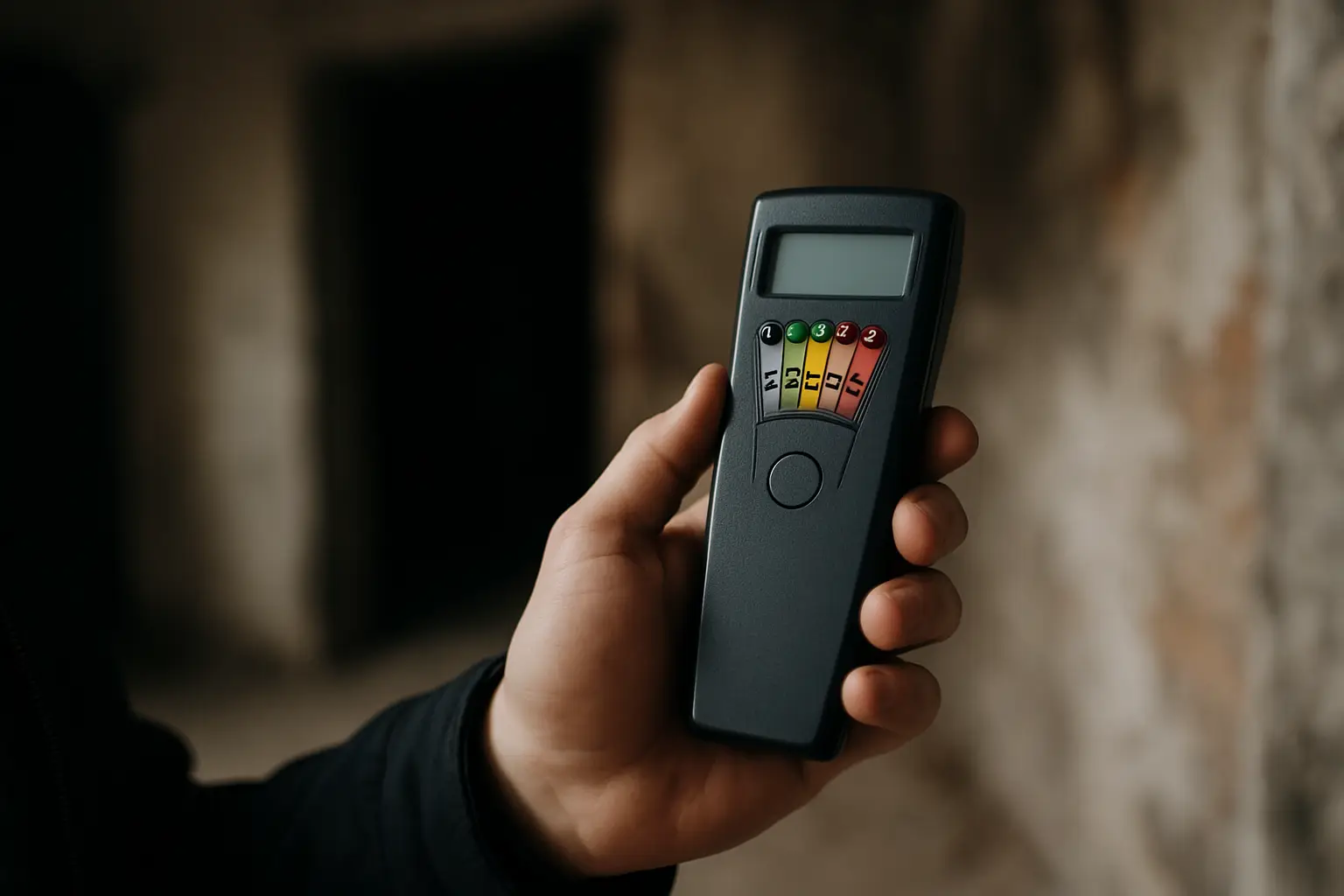
You walk into a dark, quiet location and your camera audio is clean – no buzzing lights, no HVAC rumble, no people shifting on floors. Then your EMF meter starts chirping anyway. Is that a moment… or a misread?
That question is why picking the best emf meter for ghost hunting is less about buying the “most sensitive” device and more about buying the right tool for how you investigate. EMF meters can help you spot environmental changes worth documenting, but they also happily react to very normal sources like wiring in walls, phone signals, and cheap power adapters. If you want stronger evidence capture, your EMF meter needs to support a disciplined workflow, not just create excitement.
What an EMF meter actually does on an investigation
An EMF meter measures electromagnetic fields. In practice, most ghost hunters use it to detect changes in a location over time and to correlate those changes with other data: EVP hits, temperature anomalies, motion alerts, or a direct experience reported by the team.
The key is that EMF is everywhere. Modern buildings are basically EMF ecosystems – breaker panels, outlets, hidden wiring runs, appliances, routers, TVs, and dimmer switches can all move your readings. Outdoors, power lines and transformers can do the same. That’s not a reason to avoid EMF tools. It’s a reason to choose a meter that helps you separate “consistent environmental field” from “something that just changed.”
Best EMF meter for ghost hunting: what matters most
If you’re shopping in this category, you’ll see everything from tiny novelty meters to professional instruments meant for electricians and safety compliance. For investigations, the best choice depends on whether you prioritize speed, interpretability on camera, or measurement credibility.
1) The meter type: single-axis vs tri-field vs multi-axis
Most entry-level ghost hunting meters are single-axis. They react strongly when the sensor is oriented “just right,” and they can appear quiet if you rotate them away from the field. That can create false calm or false spikes depending on how you hold it.
Tri-field meters are popular because they’re simple to use and quick to interpret. Many are designed to detect electric fields, magnetic fields, and radio/microwave activity in a broad way. They can be great for rapid sweeps and on-camera moments, but the trade-off is precision: they often tell you “something is here” without clearly telling you what kind of source it is.
Multi-axis (often 3-axis) magnetic field meters are closer to what you want for disciplined documentation because orientation matters less. If your investigation style includes mapping hotspots, repeating tests, and trying to rule out wiring and devices, this is where you start to see value.
2) Readout style: analog needle vs digital numbers
Analog needle meters are popular in paranormal content for a reason. On video, you can see the needle movement instantly without needing a close-up focus on an LCD. If you’re filming investigations, that visual clarity is a real advantage.
Digital meters can be better for documentation because they provide a number you can log. But not all digital meters are equal. Some are jumpy, some update slowly, and some hide what’s happening with aggressive smoothing. If you’re serious about evidence, you want a meter with a stable baseline and predictable response.
3) Baseline behavior: stability beats “twitchy sensitivity”
A common buying mistake is chasing the meter that reacts to everything. The more twitchy a meter is, the harder it is to establish a baseline. And if you can’t establish a baseline, you can’t confidently say a reading changed.
A good investigation-grade EMF meter is readable at rest. It shows you a stable background level, then clearly signals when you’ve introduced a new source or moved into a different field area. That makes it easier to run controlled tests: step away, return, repeat, rotate orientation, and confirm.
4) Range and resolution: don’t buy a meter that’s “all alarm”
Some ghost hunting EMF meters are basically tiered LEDs or a rough scale. They’re fun, but they compress information. A reading that could be “slightly elevated” and “very elevated” might look identical.
For real decision support, you want a meter that gives you enough resolution to tell the difference between a small fluctuation and a major change. That doesn’t mean you need lab gear. It means you want a tool that gives you more than vibes.
5) Practical field use: battery life, grip, and one-hand operation
If your meter is awkward, you’ll stop using it. That’s the most honest test.
Look for something you can operate with one hand while holding a flashlight, camera rig, or recorder. Clear buttons, a display you can read without perfect angles, and battery life you don’t have to babysit matters more than marketing claims.
The three best EMF meter “styles” for ghost hunting (and who they fit)
There isn’t one universally perfect EMF meter for every investigator. There are three common use cases, and each points to a different style of tool.
A) The on-camera investigator: go analog or high-visibility
If you run live investigations, YouTube episodes, TikTok walk-throughs, or team documentation where the audience needs to see the moment, analog needle meters (or meters with large, clear bar/LED indicators) make life easier.
The trade-off is that many high-visibility meters are less precise about what they’re reading and more likely to react to radio sources. That doesn’t make them “fake.” It means you have to treat them like a trigger tool: when it moves, you follow up with a more diagnostic check.
B) The evidence-first investigator: choose a 3-axis magnetic field meter
If your goal is repeatability and documentation, a 3-axis magnetic field meter is usually the best emf meter for ghost hunting in terms of investigative discipline.
You can do a slow baseline sweep, note hot areas near wiring, and then revisit later to see if anything changed. Because orientation plays a smaller role, you reduce one of the biggest sources of accidental spikes: the way your wrist turns as you walk.
The trade-off is that these meters can be less dramatic on camera. They’re often calmer and more “numbers-focused.” If your team equates action with proof, you’ll need to retrain your workflow: calm data is still valuable data.
C) The quick sweep buyer: tri-field meters for broad detection
If you want one tool to quickly scan a room and flag “something electrical is active here,” tri-field style meters are convenient. They’re beginner-friendly and can be useful when you’re learning to identify normal sources like outlets, routers, and breaker panels.
The trade-off is interpretation. A tri-field reading doesn’t automatically mean paranormal. It means you found a field. Your job becomes identifying whether that field has a normal explanation or shows unusual change patterns relative to baseline.
How to use an EMF meter like an investigator (not a thrill-seeker)
A good meter won’t save a sloppy process. The fastest way to level up is to run your EMF meter with controls.
Start every session with a baseline. That means you check multiple areas, especially near known electrical infrastructure. Find the breaker panel, note outlet-heavy walls, and do a slow sweep near common culprits like refrigerators, TV walls, and Wi-Fi routers. If you’re in an older building, expect inconsistent wiring and “always on” background noise.
When you get a spike, don’t chase it emotionally. Freeze your position, note the time, and call out what else is running: cameras, phone radios, walkie systems, battery packs, even your IR illuminator. Then try to reproduce it. Step back two feet, step forward again, rotate the meter, and see if the reading behaves consistently.
If the reading disappears when you rotate the device, that’s often a clue you’re using a single-axis meter or you’re near a directional source. If it stays elevated across orientations and repeats at the same location, you may have found wiring, an appliance behind a wall, or a persistent field hotspot worth documenting and avoiding as a contamination source.
The most useful habit: pair EMF changes with something else. If you get an EMF increase at the exact moment an EVP recorder captures a distinct response, or your thermal cam shows a localized shift, that’s when the moment becomes worth deeper scrutiny. Single-sensor evidence is easy to dismiss. Multi-sensor correlation is where confidence starts.
Common shopping traps (and what to do instead)
If a product description leans hard on “detects ghosts,” treat it as entertainment until proven otherwise. You want a tool built to measure fields, not promise entities.
Also watch out for meters that only give you a few LED steps with no real scale. They can still be used, but you’re limiting yourself to “quiet vs loud” instead of “how much did this change and how quickly?” If your goal is better documentation, you’ll outgrow that fast.
Finally, don’t ignore build quality. A meter that resets, flickers, or eats batteries mid-session will make you miss the moments you actually wanted to capture. Reliability is evidence insurance.
Choosing the best EMF meter for ghost hunting for your budget
If you’re building a starter loadout, it’s reasonable to begin with a high-visibility meter that helps you learn how environments behave. But if you’re already investigating regularly, consider upgrading to a more measurement-forward 3-axis magnetic field meter and using the high-visibility meter as your quick trigger tool.
That two-meter approach sounds like “extra,” but it mirrors how good investigations work: one tool helps you notice changes fast, and the other helps you validate and document those changes with less ambiguity.
If you want a curated, investigator-minded way to compare EMF meters alongside other essentials like EVP recorders and IR options, that’s exactly what we have at HauntGears.
Closing thought: the best EMF meter isn’t the one that goes off the most – it’s the one that helps you stay calm, repeat the test, and walk away with data you’d trust even after the adrenaline fades.
Discover more from Haunt Gears
Subscribe to get the latest posts sent to your email.
Leave a Reply
Your email is safe with us.