
A meter spikes in an empty hallway, and suddenly the whole investigation starts orbiting that one moment. That is exactly why people ask, are emf meters accurate? The short answer is yes, but only within the limits of the sensor, the environment, and the way the investigator uses it.
For paranormal work, EMF meters can be useful tools. They can also produce misleading readings when they are treated like proof instead of one data point in a larger process. If your goal is better evidence and fewer false positives, accuracy is less about dramatic spikes and more about understanding what the meter is actually detecting.
Are EMF meters accurate in paranormal investigations?
EMF meters are accurate at measuring electromagnetic fields when they are built properly, used within their operating range, and interpreted correctly. What they are not accurate at doing is identifying the source of a field on their own. A meter can tell you that an electromagnetic change happened. It cannot tell you whether that change came from wiring in the wall, a radio source, a nearby phone, a faulty appliance, or something unexplained.
That distinction matters. Many beginner investigators buy an EMF meter expecting it to act like a paranormal detector. In reality, it is an environmental measurement tool. It helps you notice changes, map interference, and flag moments worth documenting with other equipment.
A good investigation treats EMF data the same way a field researcher treats any single sensor reading – useful, but incomplete without context.
What an EMF meter really measures
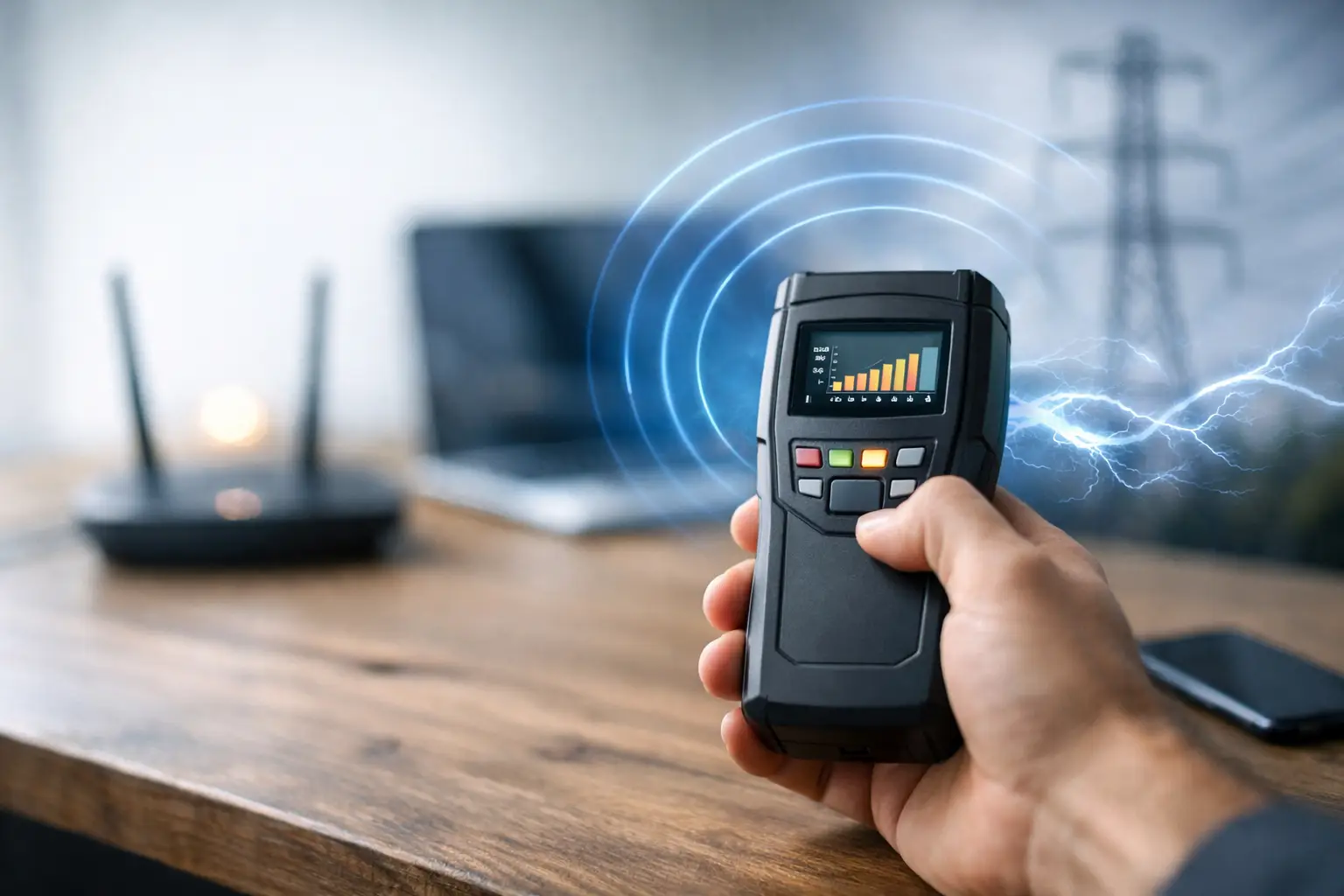
Most EMF meters used in paranormal investigations measure low-frequency electromagnetic fields, typically from household wiring, electronics, outlets, breaker panels, motors, and powered devices. Some models are broad consumer meters. Others are simplified ghost hunting meters designed to show field strength changes quickly in the dark.
Neither type is automatically better for every situation. A technical meter often gives more precise numerical data, while a ghost hunting model may be easier to monitor during active sweeps or trigger sessions. Accuracy depends on calibration, sensor design, build quality, and whether the device is measuring the kind of field present in that location.
This is where expectations often go wrong. If a meter is designed to detect one frequency range well, it may be less informative in another. If the meter has a wide tolerance or strong sensitivity without enough filtering, it may react to ordinary environmental noise more often than a better-built unit.
Why EMF readings go wrong so often
Most bad EMF interpretations do not come from broken meters. They come from contaminated environments and weak investigation methods.
Old buildings are full of normal interference. Wiring behind plaster, extension cords under rugs, fluorescent lighting, HVAC systems, refrigerators, Wi-Fi equipment, cell phones, walkie talkies, and battery packs can all affect readings. In a home or commercial site, elevated EMF may be completely explainable before the investigation even begins.
User error is another major factor. Investigators sometimes move the meter too quickly, change orientation without realizing it, stand too close to other gear, or fail to establish a baseline. Even body position can matter if you are carrying a phone, radio, or spare batteries. If the meter spikes every time the operator shifts their hand near a communication device, that is not paranormal evidence. That is poor control.
Cheap build quality can also create problems. Some low-cost meters are inconsistent from one unit to the next. Others respond dramatically to minor interference because dramatic behavior sells. A meter that reacts to everything can feel exciting in the field, but it is not helping you sort signal from noise.
Accuracy depends on the type of meter
Not all EMF meters perform the same way. Single-axis meters require the sensor to be oriented correctly relative to the field. Tri-axis meters measure across multiple directions and are generally more reliable for field work because they reduce the chance of missing a reading due to angle.
Meters with a numeric display are usually better for documentation because they let you record changes over time instead of relying on a color bar or alarm tone alone. Simpler ghost hunting meters still have value, especially for mobile sweeps, but they should be backed up with notes, timestamps, and ideally another sensor.
Sensitivity is another trade-off. A highly sensitive meter may catch subtle environmental changes, but it may also pick up more interference and generate more false positives. For serious investigations, that means the best meter is not always the one that spikes the most. It is the one that behaves consistently and gives you readings you can repeat, compare, and document.
How to test whether your EMF meter is reliable
The fastest way to improve results is to stop treating the meter as a mystery box. Test it in known conditions first.
Start by checking baseline readings in a controlled room with most electronics removed or turned off. Then bring the meter near known sources like a wall outlet, power strip, lamp cord, phone charger, or running appliance. You want to see whether the meter responds in a predictable way. If it gives random spikes with no obvious source, that is a warning sign.
Repeat the same test more than once. Good gear should show similar behavior under similar conditions. If the readings vary wildly every time you repeat the test, the device may be unstable, overly sensitive, or poorly built.
This is also the point where teams should learn the meter’s range and lag. Some units react instantly. Others have slight delay or smoothing. If you do not know how fast your meter responds, you can misread cause and effect in the field.
How investigators should use EMF meters accurately
The best use of an EMF meter is as part of a controlled workflow. Sweep the location before the active session begins. Map high-EMF zones. Identify powered sources, hidden wiring, and equipment-heavy areas. Mark those spots in your notes so nobody treats them as unexplained later.
During the investigation, keep the meter away from your own electronics whenever possible. Put phones in airplane mode if they are not needed. Keep radios and spare batteries separated from the meter. Use the same operator position and distance during repeated tests.
When you get a notable reading, do not rush to label it. First ask whether the spike can be reproduced. Check whether someone moved nearby, keyed a radio, adjusted a light, or stepped near a wall source. If the change repeats under controlled conditions with no obvious environmental cause, then it becomes more interesting.
This is where other tools matter. Pair EMF changes with audio recording, temperature logging, motion sensors, and video coverage. A standalone spike is weak evidence. A time-matched EMF change that occurs alongside a documented event is much more useful.
What accurate EMF data can and cannot tell you
Accurate EMF data can tell you that electromagnetic conditions changed at a specific time and place. It can help you identify contaminated areas, reduce false positives, and isolate moments worth deeper review. That is real value for any disciplined team.
What it cannot do is prove a haunting. It cannot identify intent, entity type, or paranormal origin. Any claim beyond measured field change requires a leap that the instrument itself does not support.
That does not make the tool pointless. It makes the tool specialized. The most credible investigators use EMF meters to narrow variables, not to make the entire case. If you approach the device that way, accuracy becomes useful instead of disappointing.
Should you trust an EMF meter reading?
Trust the reading as a measurement, not as a conclusion. If the meter is decent, tested, and used correctly, it is probably telling you that an electromagnetic field is present or changing. Whether that change matters is a separate question.
For hobbyists and newer teams, this mindset saves money and frustration. You do not need a meter that promises dramatic paranormal detection. You need one that behaves consistently, lets you establish a baseline, and helps you investigate with more control. That is the difference between collecting noise and building a case.
At Haunt Gears, the goal is not to chase the flashiest spike. It is to use the right tools to document conditions, reduce bad assumptions, and make every session more defensible.
If your EMF meter helps you rule out the ordinary before you label something unexplained, it is doing exactly what a serious investigation tool should do.
Discover more from Haunt Gears
Subscribe to get the latest posts sent to your email.

Leave a Reply
Your email is safe with us.