
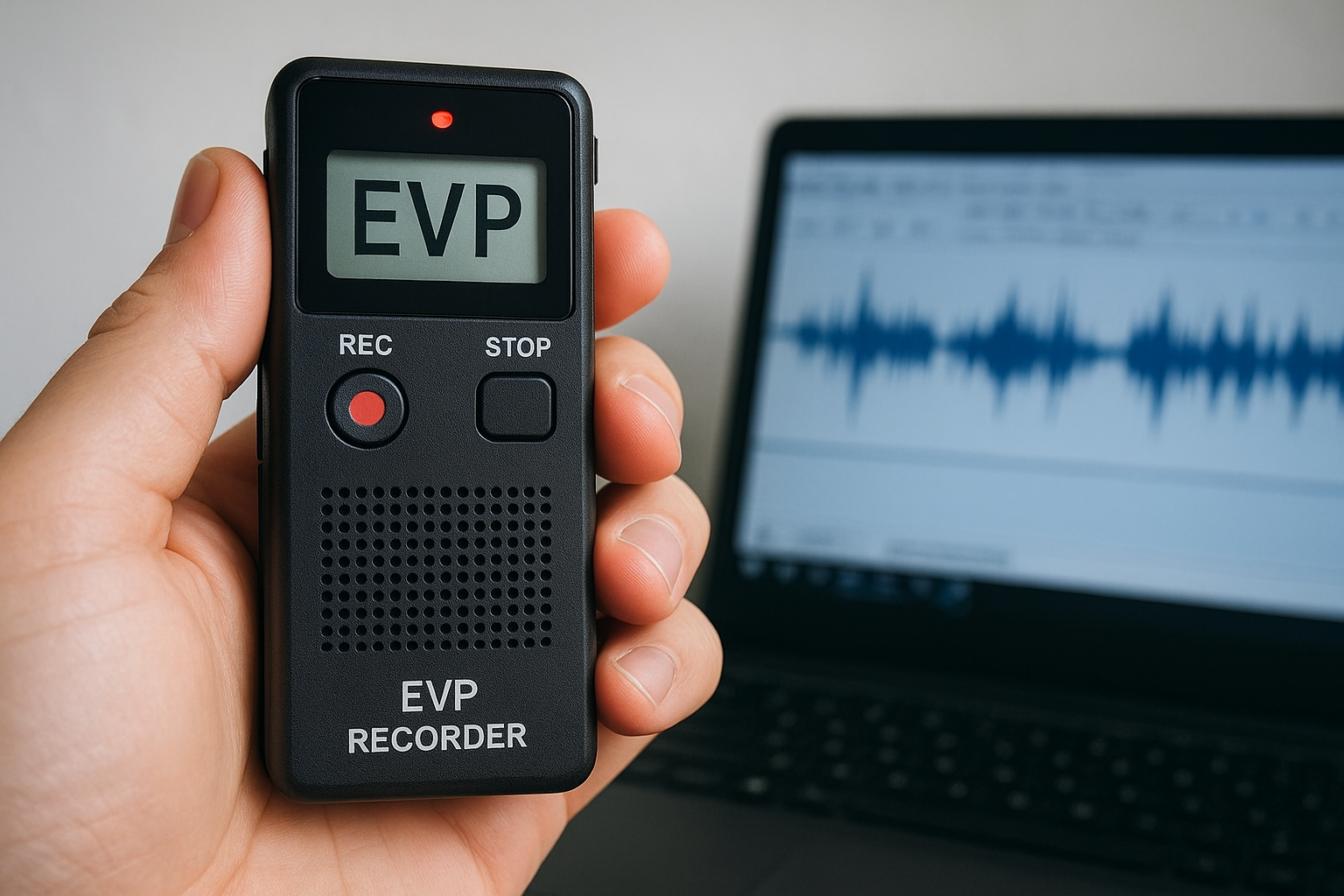
You’ve probably seen paranormal investigators on TV holding small recording devices in dark rooms, asking questions to empty air. Those devices are EVP recorders, and they’re one of the most essential tools in any ghost hunter’s kit. So, what is an EVP recorder exactly? It’s a device designed to capture Electronic Voice Phenomena: unexplained voices or sounds that weren’t audible during recording but appear on playback.
Not every voice recorder qualifies as a true EVP recorder. Standard digital voice recorders compress audio and filter out frequencies that investigators specifically want to capture. Dedicated EVP devices, on the other hand, are built to record a wider frequency range and minimize internal noise that could contaminate evidence. Understanding this distinction matters if you’re serious about documenting potential paranormal activity.
At Haunt Gears, we’ve tested dozens of recording devices to help investigators, whether beginners or seasoned researchers, find equipment that actually performs in the field. This guide breaks down how EVP recorders work, what separates quality devices from gimmicks, and how ghost hunters use them during investigations. By the end, you’ll know exactly what to look for and how to use an EVP recorder effectively on your next hunt.
Why ghost hunters use EVP recorders
Ghost hunters rely on EVP recorders because human hearing has significant limitations during paranormal investigations. Your ears can only detect sounds between 20 Hz and 20,000 Hz, and environmental factors like adrenaline and fear can make you miss subtle audio anomalies entirely. Recording devices capture everything within their frequency range, which means you can analyze sounds that occurred but went unnoticed in real time. This creates a permanent record you can review multiple times, isolating specific moments and filtering out background noise that might mask potential evidence.
EVPs capture what human ears miss
Standard hearing doesn’t work well in the dark, cold, and stressful conditions of most paranormal investigations. Your brain naturally filters out low-level sounds to focus on immediate threats or conversations, which means faint voices or whispers slip past undetected. EVP recorders preserve these sounds without the cognitive filtering that affects human perception. Investigators often discover the clearest responses during playback, long after leaving a location. The device records continuously, catching audio during moments when you’re moving equipment, taking notes, or distracted by other activity.
EVP recorders provide an objective audio record that eliminates the subjective nature of human perception during high-stress investigations.
Spirit communication requires documentation
Paranormal research demands verifiable proof, not just personal experiences or feelings. EVP recordings serve as tangible evidence that you can share with other investigators, present to location owners, or archive for future analysis. Without recorded audio, your claims about hearing voices or responses remain anecdotal and impossible to verify. Recording devices capture exact timestamps and environmental conditions, which helps you correlate audio anomalies with other equipment readings like EMF spikes or temperature drops. This synchronized data strengthens your case when you’re trying to determine whether an EVP represents genuine paranormal activity.
Audio evidence builds investigative credibility
Serious investigators need evidence that withstands scrutiny from skeptics and peers. EVP recorders provide repeatable, analyzable data that you can examine using audio software to measure frequency, amplitude, and clarity. You can share raw files with other researchers who can independently verify or debunk your findings. This level of transparency separates credible investigators from those making unsupported claims. When you understand what is an EVP recorder and use it properly, you create a foundation of documented evidence that builds your reputation within the paranormal community and helps advance the field’s legitimacy.
How an EVP recorder works
Understanding what is an EVP recorder means knowing how it captures sound differently than your smartphone or standard recording device. These devices use analog-to-digital conversion to transform sound waves into data files your computer can analyze. A microphone picks up pressure changes in the air, converts them to electrical signals, and the recorder’s processor samples these signals thousands of times per second. The sampling rate determines how much detail the device captures, which directly affects your ability to detect subtle paranormal audio.

Basic recording technology
EVP recorders use either linear PCM (Pulse Code Modulation) or WAV format to store audio without compression. Compression algorithms like MP3 or AAC remove frequencies and details to reduce file size, which means potential EVPs might disappear during the encoding process. When you record in uncompressed formats, you preserve every frequency the microphone detects, giving you clean source material for analysis. The recorder’s analog-to-digital converter (ADC) quality matters because cheap converters introduce noise and artifacts that contaminate your recordings with false positives.
High-quality EVP recorders also include low-noise preamplifiers that boost weak signals before digitization occurs. This amplification happens before the signal reaches the ADC, which preserves faint sounds that might contain paranormal voices. Better devices let you adjust gain settings manually, giving you control over how sensitively the recorder responds to quiet environments.
Quality EVP recorders prioritize clean signal paths and minimal internal noise over features like voice activation or automatic gain control.
Frequency range and sensitivity
Your recorder’s frequency response determines which sounds it can actually capture. Most human speech occurs between 300 Hz and 3,400 Hz, but paranormal researchers target frequencies from 20 Hz to 20,000 Hz or higher. EVP recorders with extended frequency ranges can detect ultrasonic and infrasonic sounds that standard voice recorders filter out automatically. You want a device with flat frequency response, meaning it captures all frequencies equally without boosting or cutting specific ranges. This neutral recording gives you accurate audio data for later analysis instead of pre-filtered material that might miss critical evidence.
How to record EVP step by step
Recording EVPs requires methodical preparation and consistent technique to produce usable evidence. You can’t just press record and hope for results. Understanding what is an EVP recorder means knowing how to use it properly during investigations. Each step in the process matters because poor recording practices introduce false positives that waste your analysis time and damage your credibility. Follow this structured approach to capture clean audio that stands up to scrutiny.

Prepare your recording environment
Survey your location before you start recording to identify potential contamination sources. Air conditioning units, refrigerators, traffic noise, and electrical hum all create sounds that can mask genuine EVPs or produce false readings. Turn off HVAC systems, silence your cell phone completely, and ask everyone present to remove keys, coins, and loose items that might create unexpected sounds. Test your recorder in different spots within the investigation area to find positions with minimal baseline noise. Document these environmental conditions in your investigation notes so you can reference them during later analysis.
Set your device parameters
Configure your EVP recorder to capture uncompressed audio at the highest quality setting your device supports. Set your sampling rate to at least 44.1 kHz and choose WAV or linear PCM format instead of compressed options. Disable any automatic gain control or noise reduction features because these filter out frequencies you need to preserve. Adjust your manual gain setting by recording a test clip and checking levels. Your audio should peak between negative 12 and negative 6 dB to avoid distortion while capturing quiet sounds.
Proper device configuration prevents audio processing from destroying potential paranormal evidence before you even start reviewing files.
Conduct your EVP session
Press record and announce the date, time, location, and your name clearly at the start of every session. This creates context for later analysis and helps you organize files. Ask your questions slowly with at least 30 seconds of silence between each one, giving potential responses time to occur. Speak your questions at normal volume and avoid whispering or shouting, which creates audio artifacts. Note any physical sounds you make during recording, like footsteps or equipment adjustments, so you don’t mistake them for EVPs during playback.
EVP recorder vs voice recorder and apps
You might wonder whether you actually need a specialized EVP recorder when your smartphone or digital voice recorder already captures audio. The difference comes down to how these devices process sound and what frequencies they preserve. When you understand what is an EVP recorder compared to consumer recording devices, you realize that standard equipment actively filters out the exact frequencies paranormal researchers need to capture. This technical distinction separates legitimate investigation tools from convenient but inadequate alternatives.
Dedicated EVP recorders vs standard voice recorders
Standard digital voice recorders compress audio files to save storage space and optimize recordings for human speech clarity. These devices use automatic gain control (AGC) that normalizes volume levels, which means quiet sounds get amplified and loud sounds get reduced. While this feature makes meetings and lectures easier to hear, it introduces artifacts and processing noise that contaminate paranormal evidence. The compression algorithms strip out frequencies below 300 Hz and above 3,400 Hz because they fall outside typical speech ranges.
Dedicated EVP recorders preserve uncompressed audio across extended frequency ranges, typically from 20 Hz to 20,000 Hz or higher. You get manual gain control instead of AGC, which gives you precise control over recording sensitivity without automatic processing. These devices use higher-quality microphones and preamplifiers that introduce minimal self-noise, keeping your recordings clean.
Professional EVP recorders sacrifice convenience features for audio fidelity, giving you raw data instead of processed sound files.
Smartphone apps and their limitations
Smartphone recording apps face even more severe limitations than standard voice recorders. Your phone’s built-in microphone prioritizes voice calls, not wide-spectrum audio capture. Apps have no control over your device’s hardware processing, which means automatic noise cancellation and audio enhancement happen before the app even receives the signal. These background processes remove sounds your phone interprets as unwanted noise, which often includes the subtle frequencies that contain potential EVPs.
How to review audio and avoid false EVPs
Reviewing your recordings demands critical listening skills and systematic analysis to separate genuine evidence from environmental noise. You need to approach each file skeptically, assuming every sound has a natural explanation until you can rule out contamination sources. Most investigators waste hours analyzing false positives because they skip basic quality control steps before diving into paranormal interpretation. Understanding what is an evp recorder means knowing that the device captures everything, which makes your analysis method more important than your recording equipment.
Listen systematically with audio software
Import your uncompressed audio files into software like Audacity or Adobe Audition that displays waveforms and frequency data visually. Listen to your entire recording at normal speed first to identify obvious contamination like footsteps, wind, or equipment noise. Mark any potential EVPs with timestamp notes and visual markers so you can return to specific sections. Replay suspected EVPs multiple times at different volume levels because your brain interprets familiar sounds differently with each pass. Use spectrum analysis tools to examine frequency content and verify that potential voices contain harmonics consistent with human speech patterns rather than random noise.
Audio software reveals visual patterns that help you distinguish structured voice phenomena from equipment artifacts or environmental sounds.
Identify common contamination sources
False EVPs typically come from radio frequency interference, pareidolia, or unnoticed physical sounds during your session. Your recorder picks up CB radio transmissions, baby monitors, and wireless devices that create voice-like patterns in your audio. Check your recordings against local radio station frequencies and emergency service bands to rule out broadcast contamination. Pareidolia causes you to hear meaningful patterns in random noise, especially when you expect to find voices. Wind passing through cracks, HVAC systems cycling, and building settling all produce sounds that mimic speech cadences when you listen with confirmation bias. Compare suspicious audio against your investigation notes documenting physical events and environmental conditions to verify whether natural explanations exist.

Next steps
You now understand what is an EVP recorder and how it differs from standard recording devices. The key takeaway is that specialized equipment captures frequencies consumer devices actively filter out, which directly affects your ability to document genuine paranormal evidence. Your next move depends on where you are in your investigation journey.
Start by testing your current recording setup against the principles covered in this guide. If you’re using a smartphone app or compressed audio formats, you’re working with limited data that might miss critical evidence. Review your existing recordings with proper audio software and systematic analysis techniques to see what you might have overlooked.
Ready to upgrade your investigation toolkit? Haunt Gears offers expert-tested EVP recorders and starter kits designed for both beginners and experienced investigators. Our detailed product reviews help you choose equipment that actually performs in the field, backed by real testing and a 30-day return policy.
- Paranormal Research Tools6 products
- Advanced EMF Meter10 products
- Infrared Night Vision Camera3 products
- Multi-Function3 products
- Paranormal Communication Devices9 products
- Paranormal Investigation Guidebook6 products
- Starter Kits6 products
- Thermal Camera7 products
Leave a Reply